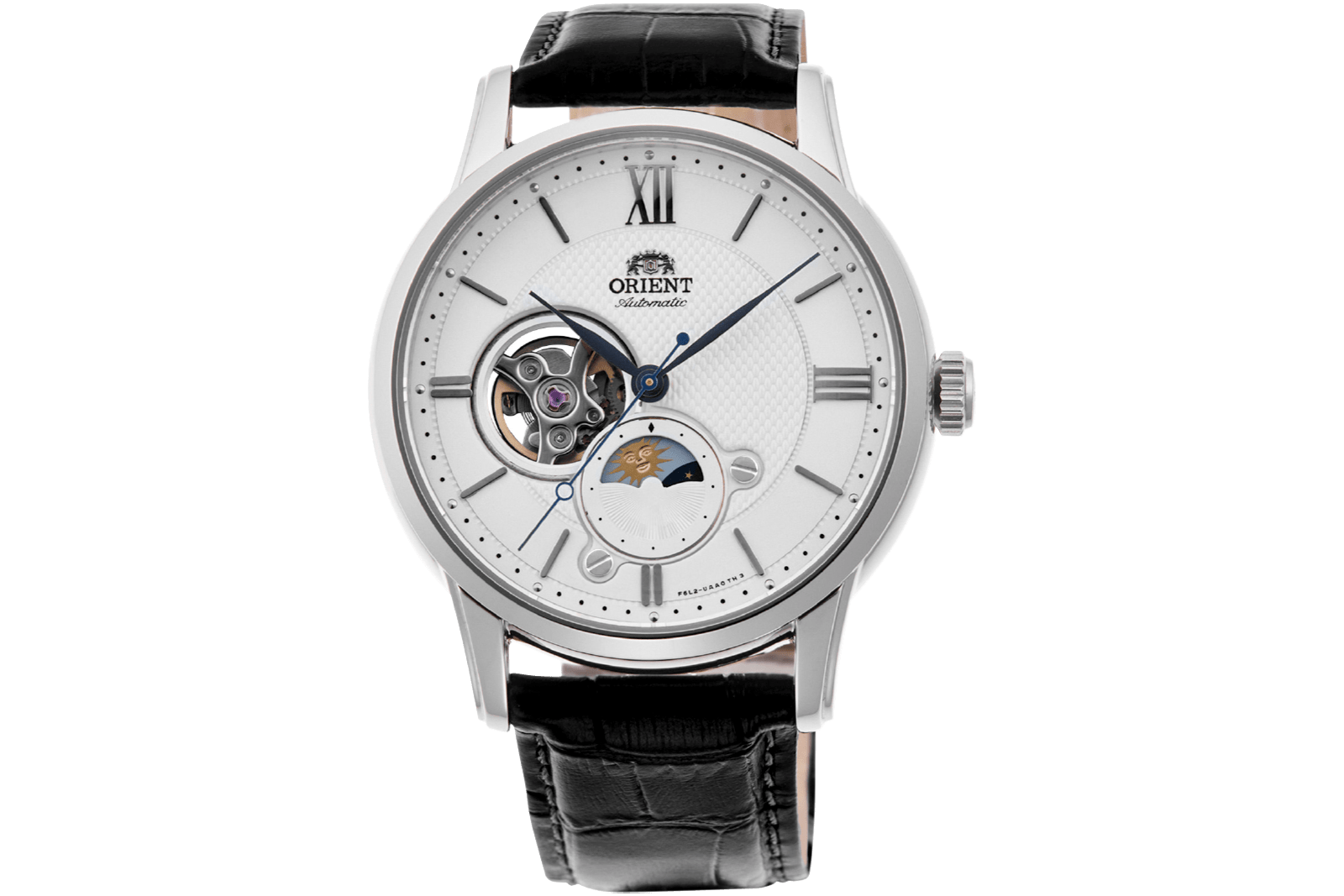
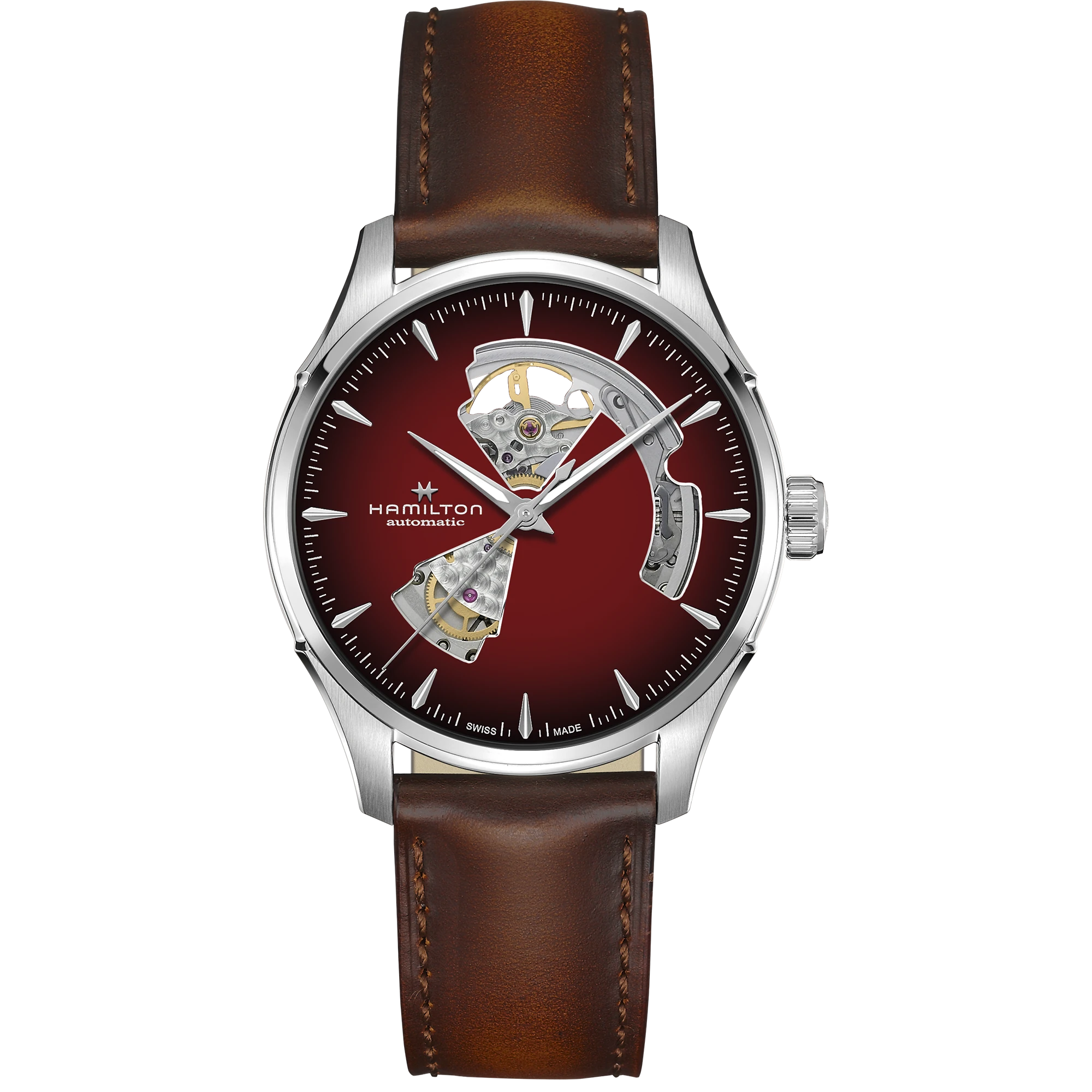
For most buyers the Orient AS00 Open Heart is the one to buy, because it delivers the open-heart look, a domed sapphire crystal and an in-house automatic for $450. The Hamilton Jazzmaster Open Heart Auto at $1,245 is the better watch, and its real advantage is a movement that runs twice as long.
An open-heart dial cuts a window over the balance wheel so you can watch the movement beat from the front. Both of these watches do that, and both have display backs as well. After that they part ways on price, size and, most of all, how long they keep running when you take them off.
| OrientAS00 Open Heart | HamiltonJazzmaster Open Heart Auto 40mm | |
|---|---|---|
| Price (US) | $450 (edge) | $1,245 |
| Reference | RA-AS0011S30B | H32675570 |
| Movement | Orient F6L24, automatic | Hamilton H-10 (Nivachron balance spring), automatic |
| Power reserve | About 40 hours | 80 hours (edge) |
| Rated accuracy | +25/−15 sec/day (static) | Not published |
| Hacking / hand-winding | Yes / Yes | Not published |
| Jewels | 22 | Not published |
| Beat rate | 21,600 vph | Not published |
| Case diameter | 42mm | 40mm |
| Thickness | 14mm | 11.05mm (edge) |
| Lug to lug | 49.5mm | Not published |
| Lug width | 21mm | 20mm |
| Crystal | Domed sapphire | Sapphire, anti-reflective coating (edge) |
| Caseback | Exhibition | Open (display) |
| Water resistance | 50m | 50m |
| Bezel | Fixed | Not published |
| Crown | Push/pull | Not published |
| Bracelet / strap | Black leather, deployant clasp | Brown calf leather, pin buckle |
| Warranty | 3 years (Orient Watch USA) (edge) | 2 years (international) |
Price
The AS00 Open Heart in white, reference RA-AS0011S30B, is $450 at Orient Watch USA. The Jazzmaster Open Heart Auto 40mm in burgundy, reference H32675570, is $1,245 at Hamilton, which listed it as in stock when we checked.
The gap is $795. Put differently, the Hamilton costs 2.77 times as much. A gap that size needs a concrete answer, and the clearest one on either spec sheet is power reserve.
What does the extra $795 buy, hour by hour?
The Hamilton’s H-10 automatic is rated for 80 hours. Orient rates the AS00’s caliber F6L24 at about 40 hours, and Epson’s user guide for the movement says 40 hours minimum. That is 40 more hours of running for $795.
Our calculation, the price difference divided by the extra reserve, comes to $19.88 for each additional hour.
Hours are abstract, so we also ran both figures against the 62-hour weekend from our power reserve test. Take the watch off fully wound at 6pm on Friday, and put it back on at 8am on Monday.
| Orient AS00 Open Heart | Hamilton Jazzmaster Open Heart | |
|---|---|---|
| Rated power reserve | About 40 hours | 80 hours |
| Stops, if fully wound at 6pm Friday | Sunday about 10am | Tuesday about 2am |
| Against a 62-hour weekend | 22 hours short | 18 hours to spare |
The assumption in that table is a full wind. An automatic worn lightly may not be fully wound when it comes off, which shortens both figures. Both watches can be wound by hand, and Epson says about 30 turns of the crown fully winds the Orient.
If you wear one watch every day, 40 hours is enough and the calculation barely matters. If you rotate watches or wear this one only at weekends, the Hamilton’s reserve is a daily convenience you will notice.
Movement
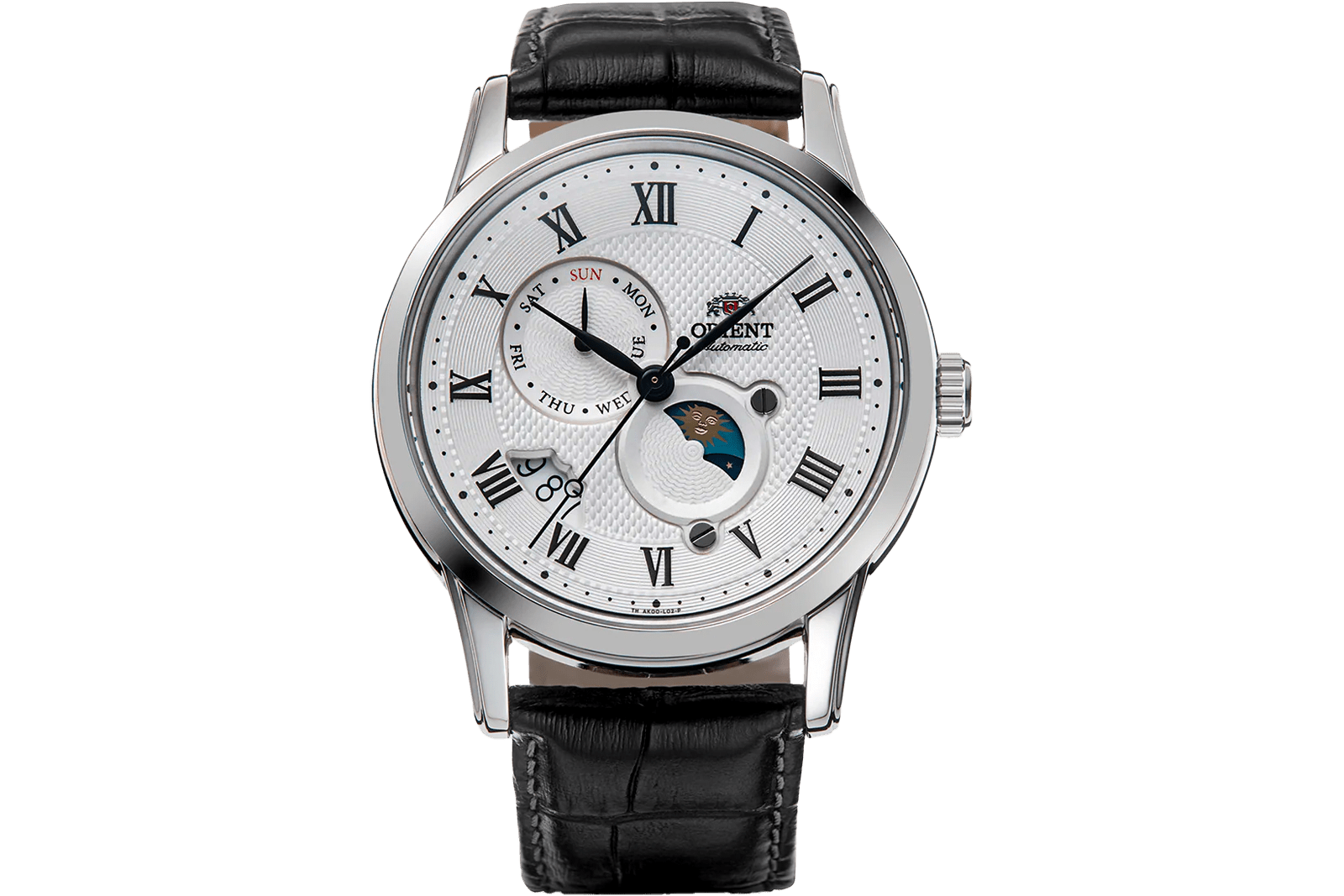
The Orient’s F6L24 is made by Epson, Orient’s parent company. It beats at 21,600 vibrations per hour, has 22 jewels, hacks for precise setting and can be wound by hand. Epson rates it at +25 to −15 seconds a day, measured static, and lists Type 1 magnetic resistance. It also drives a 24-hour sun-and-moon disc just above 6 o’clock, which turns with the hour hand and shows whether the time is day or night. Our explainer on 24-hour displays covers how Orient’s versions work.
The Hamilton’s H-10 adds a Nivachron balance spring, which Hamilton says resists magnetic fields and improves accuracy. Hamilton does not publish a daily rate for this watch, so we cannot set the two accuracy figures side by side.
Best Movement goes to the Hamilton for its doubled reserve and its anti-magnetic hairspring. The Orient’s movement does more, with its day-and-night disc, but the Hamilton’s does the basic job for longer.
Dial and Design
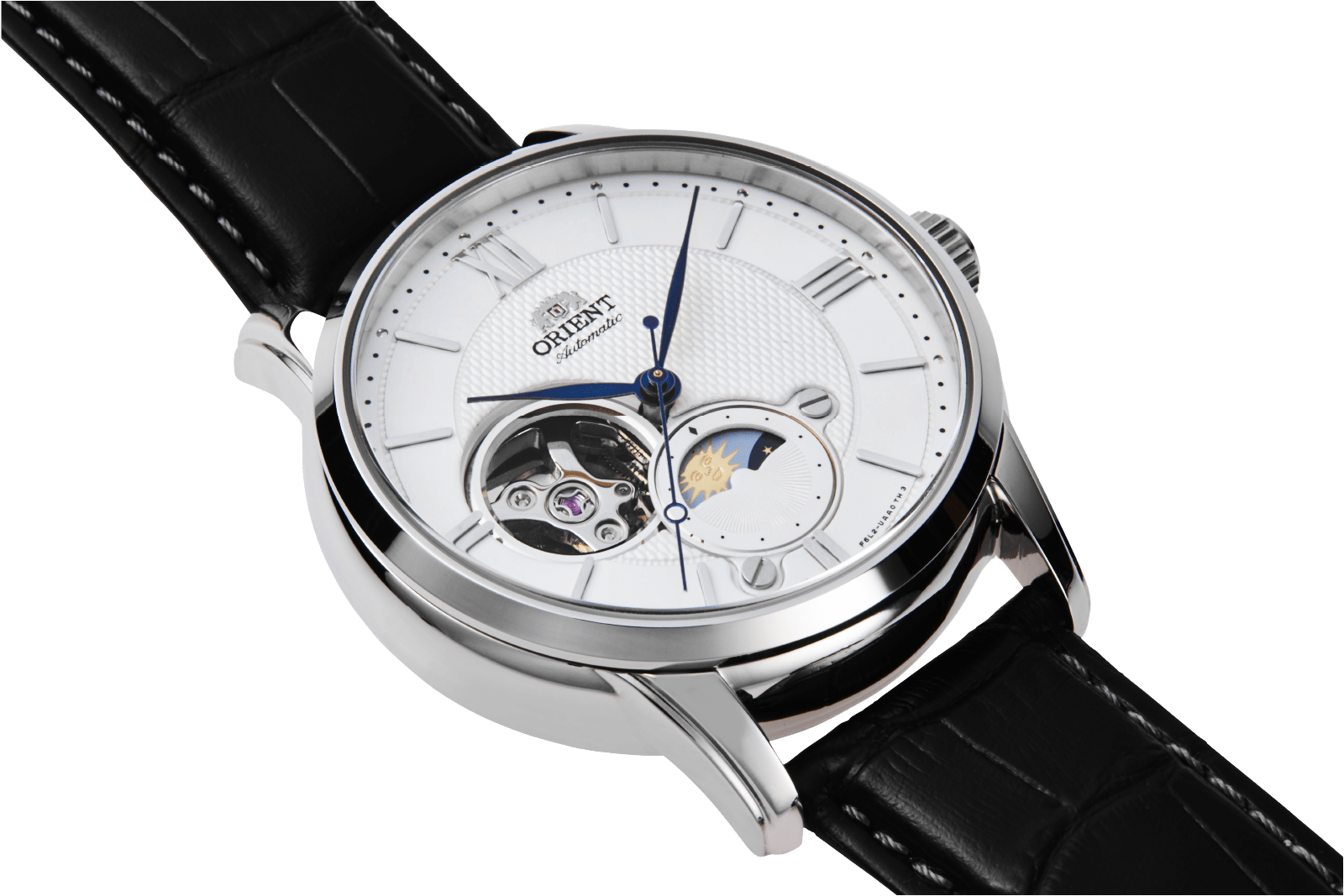
The AS00’s white dial mixes Roman numerals at 12, 3 and 6 with applied baton markers, under blue hands. The open-heart aperture sits left of center and the sun-and-moon display just above 6. There is no date. Orient puts a domed crystal over it, and the overall look is classical and fairly busy.
The Hamilton’s burgundy dial is what Hamilton calls a smoked cut-out dial, opened up to show parts of the movement. It is a three-hand watch with no date and no second display, and it reads as the more modern design.
We have not awarded the dial. One is traditional and one is contemporary, and readers will choose on taste.
Case and Dimensions
Hamilton wins the case rows. The Jazzmaster is 40mm across and 11.05mm thick, with 20mm lugs. The AS00 is 42mm across and 14mm thick, with 21mm lugs. That is nearly 3mm of extra height on the Orient.
Orient publishes a lug-to-lug of 49.5mm for the AS00. Hamilton does not publish one for the Jazzmaster, so we cannot compare that row.
Both are 50m water resistant, which covers rain and washing, and neither is meant for swimming on a leather strap.
Crystal
Both use sapphire. Hamilton specifies an anti-reflective coating, which cuts glare on the dial. Orient does not list a coating for the AS00, but its sapphire is domed, which suits the classical design. The row goes to Hamilton for the stated coating.
On the Wrist
By the published figures, the Hamilton is the slimmer and more compact dress watch. At 11.05mm it will slip under a shirt cuff more easily than the 14mm Orient.
The AS00’s 49.5mm lug-to-lug makes it a large dress watch. Readers with wrists under about 6.5 inches should check that figure against a watch they already own. The Orient comes on black leather with a deployant clasp, and the Hamilton on brown calf leather with a pin buckle.
Quality and Long-Term Ownership
Best Build goes to the Hamilton. A thinner case, anti-reflective sapphire and a longer-running movement are the clearest quality markers either spec sheet offers.
The warranty runs the other way. Orient Watch USA gives three years, and Hamilton gives a two-year international warranty. Both watches will need a mechanical service in time.
Value
Best Value goes to the Orient, and by a wide margin. For $450 it offers an in-house automatic you can watch through both sides, a domed sapphire crystal, a sun-and-moon display and a three-year warranty. The money left over from the Hamilton’s price would buy a second AS00 and still leave $345.
The Hamilton’s value is in refinement and reserve. If you want a watch that sits flatter, resists magnetism better and runs through the weekend, it delivers all three. You pay $19.88 an hour for the extra reserve, on our arithmetic, and the rest of the price buys the slimmer case, the coated crystal and the anti-magnetic hairspring.
Verdict
- Best Value
- Orient AS00 Open Heart
- Best Movement
- Hamilton Jazzmaster Open Heart Auto 40mm
- Best Build
- Hamilton Jazzmaster Open Heart Auto 40mm
- Editor’s Pick
- Orient AS00 Open Heart
The Hamilton Jazzmaster Open Heart Auto is the better watch. Its 80-hour reserve, 11.05mm case, anti-reflective sapphire and Nivachron hairspring earn it Best Movement and Best Build.
The Orient AS00 Open Heart takes Best Value and our Editor’s Pick. At $450, it costs $795 less, adds a sun-and-moon display, uses domed sapphire and comes with a longer warranty. Its weaknesses are plain on paper, a 14mm case and a 40-hour reserve that will not cover a weekend off the wrist.
If you will wear it most days, buy the Orient. If it will sit in a rotation and you want it running on Monday, the Hamilton’s extra cost is easier to justify.