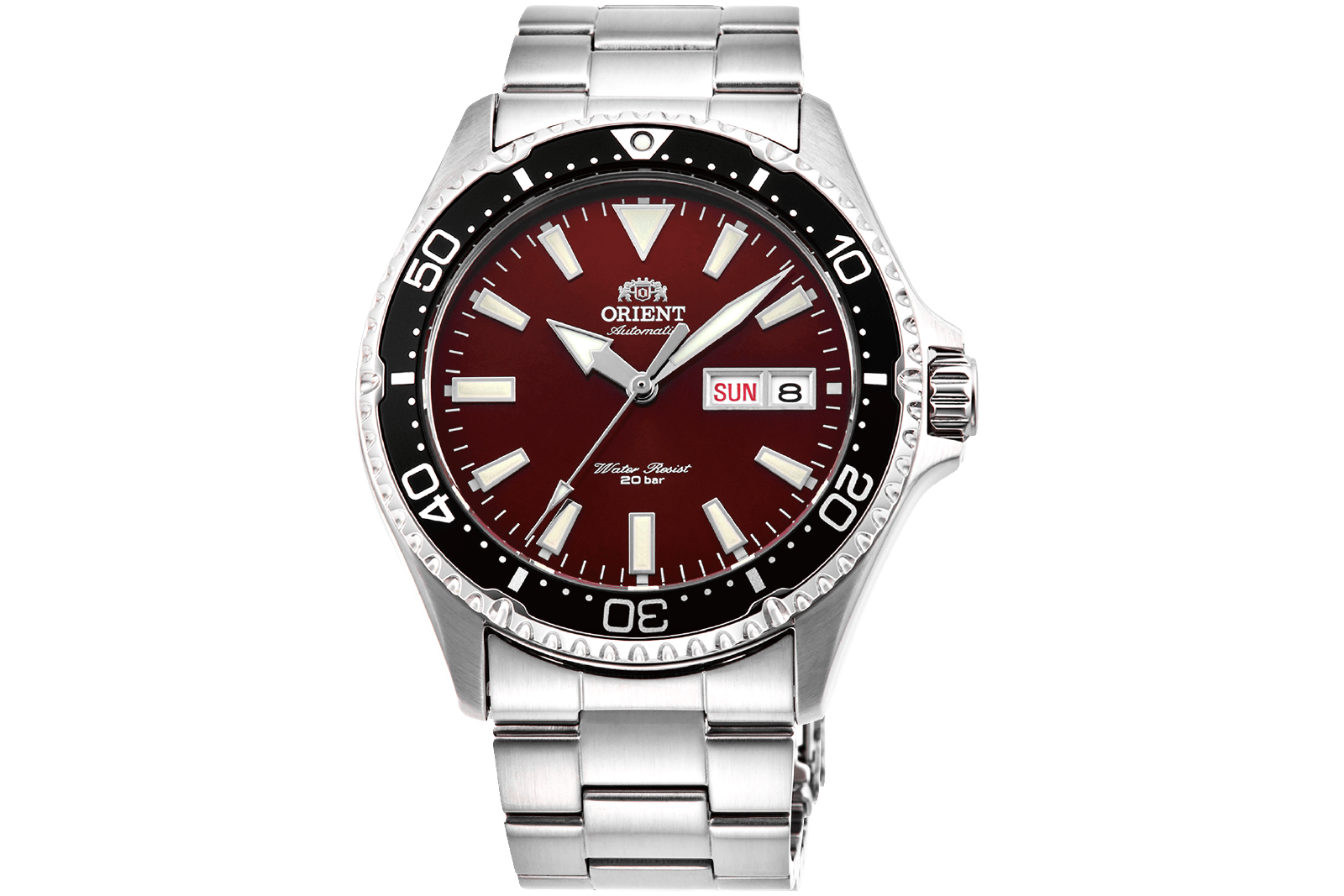
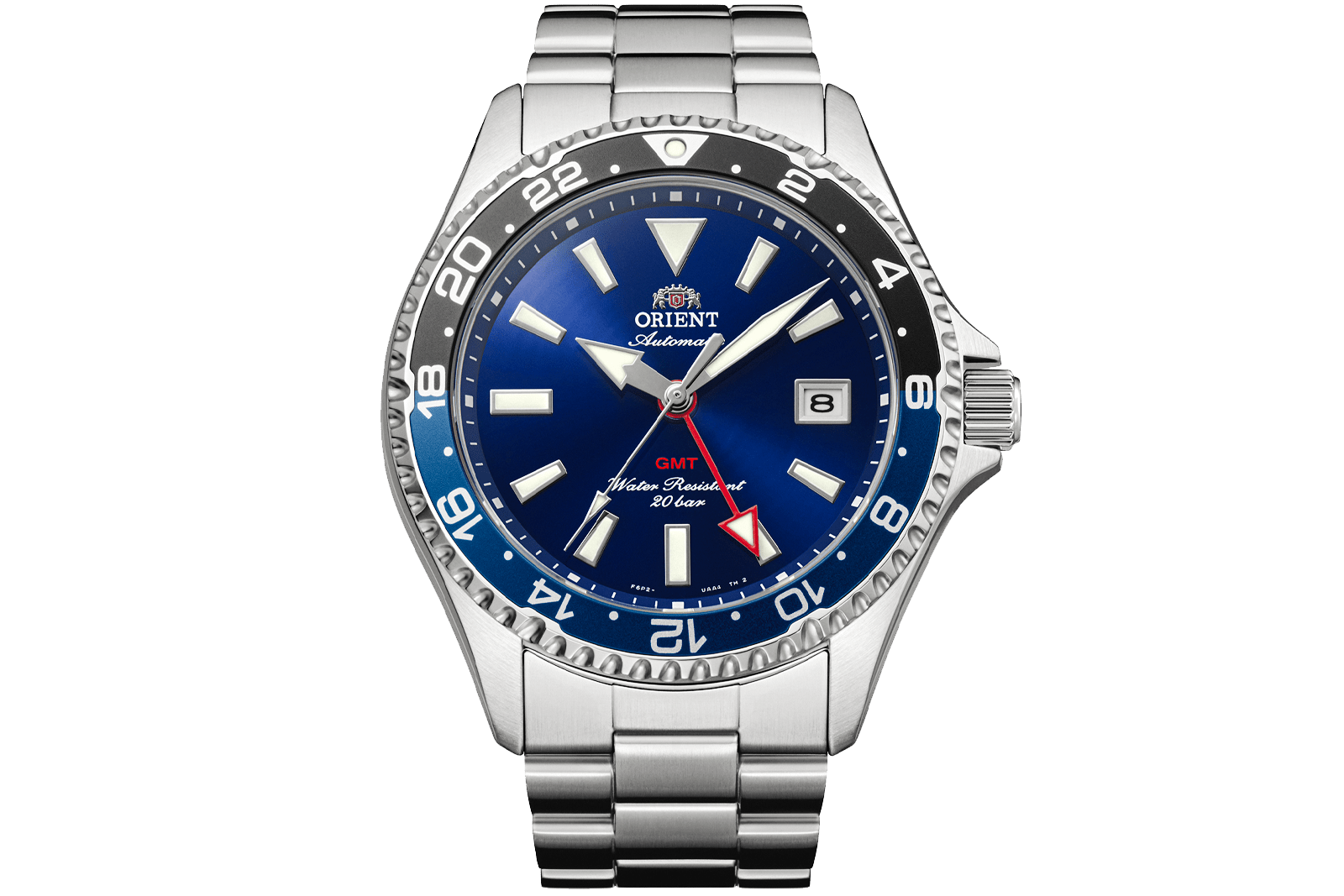
The Orient Kamasu GMT is a 42.8mm, 200m dive-style watch with a sapphire crystal and an in-house automatic caliber, the F6P22, and its 24-hour hand is locked to the hour hand, so it tracks a second time zone through the bezel rather than by setting the hand on its own. It costs $495 at Orient Watch USA in black, green, blue or orange, and a limited blue edition (RA-BC0005L30B) is $545.
That last detail about the hand matters more than it sounds. Some launch coverage described the Kamasu GMT as having an independently adjustable 24-hour hand. Epson, which owns Orient and publishes the user guide for the F6P2 caliber, says the opposite in a boxed caution. “The 24-hour hand is synchronized with the hour and minute hands, and this cannot be adjusted independently.” This profile works from that manual and from Orient Watch USA’s product pages, which we read on November 9, 2026. We have not handled the watch.
What is in the case?
The F6P22 is a 22-jewel automatic that beats at 21,600 vibrations per hour (3Hz). Epson rates it at +25 to −15 seconds a day, measured static at room temperature, and gives a running time of over 40 hours from a full wind. It winds by hand as well as by its rotor (about 30 turns of the crown from a stop, per the manual), and it hacks, which means the seconds hand stops when the crown is pulled to set the time. Epson lists its magnetic resistance as Type 1, the basic grade it describes as “reinforced to withstand magnetism”.
Those figures match the F6922 in the standard Kamasu and the rest of Orient’s current F6 family. The F6P22 is not a better movement. It is a different one, with a fourth hand and without the day disc.
| Price (US) | $495 |
|---|---|
| Reference | RA-BC0003L30B |
| Movement | Orient F6P22, automatic |
| Power reserve | About 40 hours |
| Rated accuracy | +25/−15 sec/day |
| Hacking / hand-winding | Yes / Yes |
| Jewels | 22 |
| Beat rate | 21,600 vph |
| Functions | Hours, minutes, seconds, 24-hour hand, date |
| Case diameter | 42.8mm |
| Thickness | 13.4mm |
| Lug to lug | 49.5mm |
| Lug width | 22mm |
| Case material | Stainless steel |
| Crystal | Sapphire |
| Water resistance | 200m |
| Bezel | Unidirectional 120-click, 24-hour scale |
| Crown | Screw-down |
| Dial | Blue, luminous hands and markers, date at 3 |
| Lume | Hands and markers |
| Bracelet / strap | Steel bracelet, solid end links, fold-over clasp with safety |
| Warranty | 3 years (Orient Watch USA) |
The case keeps the Kamasu’s recipe. Sapphire crystal, 200m of water resistance, a screw-down crown, a 120-click unidirectional bezel and a steel bracelet with a fold-over clasp and safety. Orient lists solid end links for the GMT, the pieces of bracelet that meet the case, and says so in the product description. The dial reads “Water Resistant 20 bar”. Orient makes no ISO 6425 dive watch claim for it, which its M-Force divers do carry.
What does the GMT add over a regular Kamasu?
The cleanest way to judge the GMT is against the watch it is built from. We put the two spec tables side by side, both from Orient Watch USA, and worked out the differences.
| Spec (Orient Watch USA) | Kamasu (RA-AA0003R39B) | Kamasu GMT (RA-BC0003L30B) | Difference |
|---|---|---|---|
| Price | $375 | $495 | +$120 (32% more) |
| Caliber | F6922 | F6P22 | GMT hand added, day removed |
| Displays | Time, day, date | Time, 24-hour hand, date | One function swapped |
| Diameter | 41.8mm | 42.8mm | +1.0mm |
| Lug-to-lug | 47mm | 49.5mm | +2.5mm |
| Thickness | 12.8mm | 13.4mm | +0.6mm |
| Lug width | 22mm | 22mm | Same |
| Bezel scale | 60-minute | 24-hour | Different job |
| Crystal, water resistance | Sapphire, 200m | Sapphire, 200m | Same |
| Power reserve | About 40 hours | About 40 hours | Same |
Our compilation from the two product pages on orientwatchusa.com, November 9, 2026. Lug-to-lug is the distance from the tip of the top lugs to the tip of the bottom lugs, and it decides how much wrist a watch covers.
Three things stand out. First, $120 buys a 24-hour hand and a 24-hour bezel, and costs you the day of the week. If you read the day off your watch, the GMT is a step backward.
Second, the case grows more in length than in width. A 2.5mm longer lug-to-lug is the bigger change for anyone with a smaller wrist, because the lugs are what overhang. At 49.5mm the GMT sits close to the 50.5mm of Orient’s 44mm Kanno, according to Orient’s own figures.
Third, the bezel changes purpose. The regular Kamasu’s 60-minute scale times a dive or a parking meter. The GMT’s 24-hour scale cannot do that, so the GMT is a travel watch in a diver’s case rather than a diver with a bonus.
How does the 24-hour hand work?
The 24-hour hand goes around the dial once a day and is geared to the hour hand. With the bezel’s zero at the top, Epson’s manual says, the 24-hour hand simply shows local time on a 24-hour scale, which tells you whether it is 10:10 in the morning or 22:10 at night.
To read a second zone, you turn the bezel. The bezel only turns counterclockwise, and the manual gives a formula for how far.
- Hours to turn = (the other city’s offset from GMT) minus (your city’s offset from GMT).
- If the answer is negative, add 24.
The 24-hour hand then points to the other city’s time on the bezel. Epson’s own example is Tokyo (+9) to Paris (+1), which gives −8, plus 24 makes 16 hours of counterclockwise rotation.
We ran the same formula for two US home cities, using the standard-time offsets in Epson’s city list. Cities the manual marks as observing daylight saving time move by an hour for part of the year, so check the offset on the day.
| Home city | London (+0) | Paris (+1) | Dubai (+4) | Tokyo (+9) | Honolulu (−10) |
|---|---|---|---|---|---|
| New York (−5) | 5 hours | 6 hours | 9 hours | 14 hours | 19 hours |
| Los Angeles (−8) | 8 hours | 9 hours | 12 hours | 17 hours | 22 hours |
Our calculation using the formula and offsets in Epson’s user guide for Cal. F6P2 (BC). Each figure is the number of hours to turn the bezel counterclockwise from zero.
The result is a two-zone watch. Home time sits on the hour and minute hands and, in 24-hour form, on the hand against an unturned bezel. The second zone is on the bezel. What you cannot do is put the 24-hour hand on a third time and leave the bezel for a fourth, as a watch with an independently set 24-hour hand allows.
What does the fixed hand mean in practice?
A watch whose 24-hour hand can be set on its own, often called a “caller” or “office” GMT, lets you keep the hand on a second zone and still use the bezel for a third. A watch whose local hour hand jumps on its own, usually called a “flyer” GMT, lets a traveler change local time in one-hour steps without stopping the watch. The F6P22 does neither. Changing local time means pulling the crown to the time-setting position, which stops the seconds hand, and turning the hands round.
That is a real limit for frequent flyers. It matters much less to someone who lives in one place and wants to know the time where family or colleagues are, because the bezel setting stays put until you change it.
The F6P22 is not a better movement than the F6922. It is a different one, with a fourth hand and without the day disc.
Two smaller points from the manual are worth knowing before you set it. Epson says not to change the date between 8 p.m. and 4 a.m., when the calendar is already turning over. And when you set the time, the date changes at midnight, so if the date flips while you are winding the hands forward, you are on the a.m. side.
Who is it for?
On paper, the Kamasu GMT suits a buyer who already likes the Kamasu’s case and wants one extra time zone without moving up to a watch with an independently set GMT hand. The F6P22 gives the same accuracy rating and reserve as the standard model, the case keeps its sapphire and 200m rating, and the bracelet gains solid end links. Our Kamasu review covers that case in more detail.
It suits a frequent flyer less well, because of the hand, and a smaller wrist less well, because of the 49.5mm lug-to-lug. It also suits a day-of-the-week reader less well than the $375 Kamasu, which keeps that window.
The four regular colors are all in stock at Orient Watch USA as of November 9, 2026, as is the limited blue edition. The next thing to watch is Epson’s own spec page for the F6P2 family. If Orient adds a version with an independently set hand, the manual will be the first place it shows up.