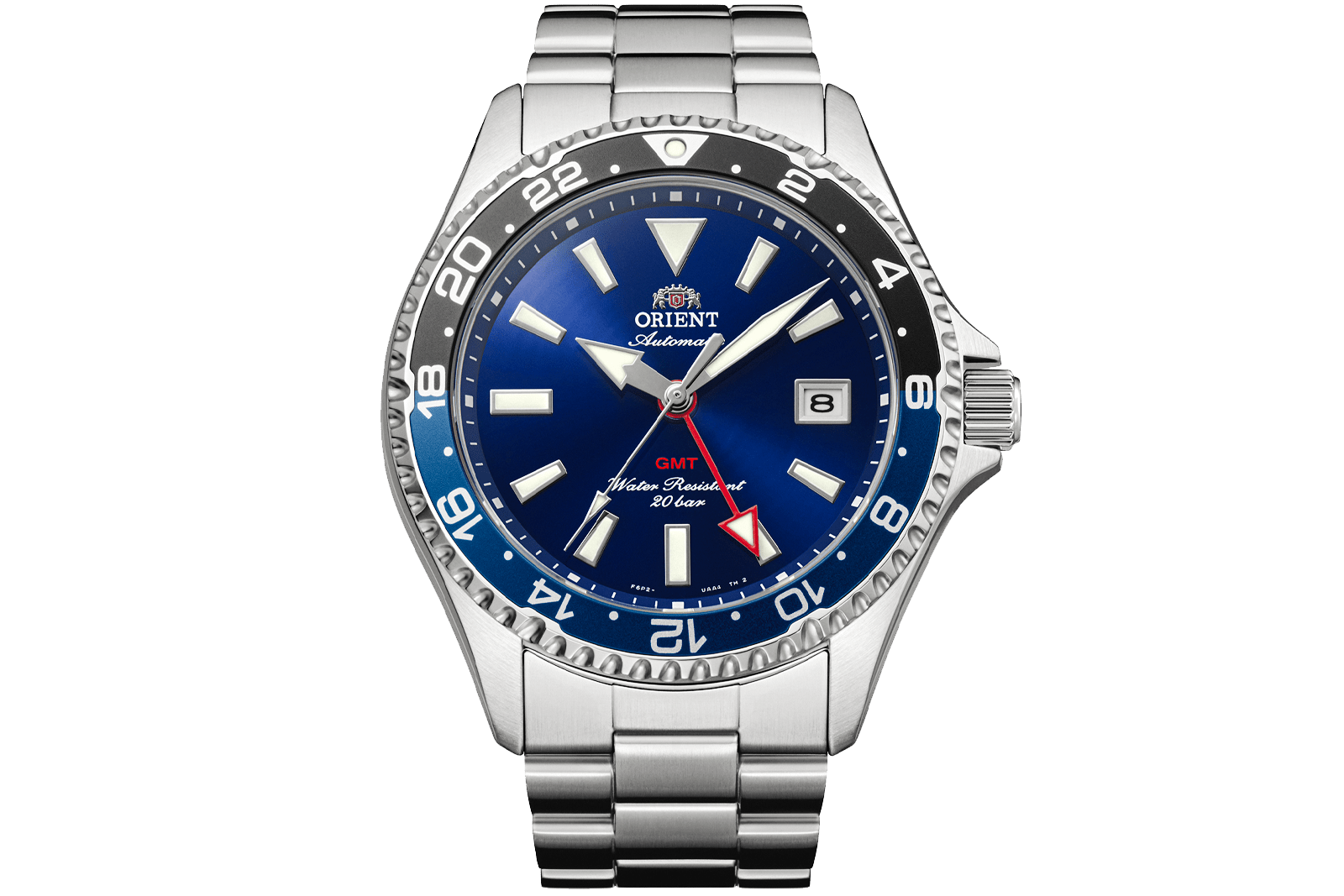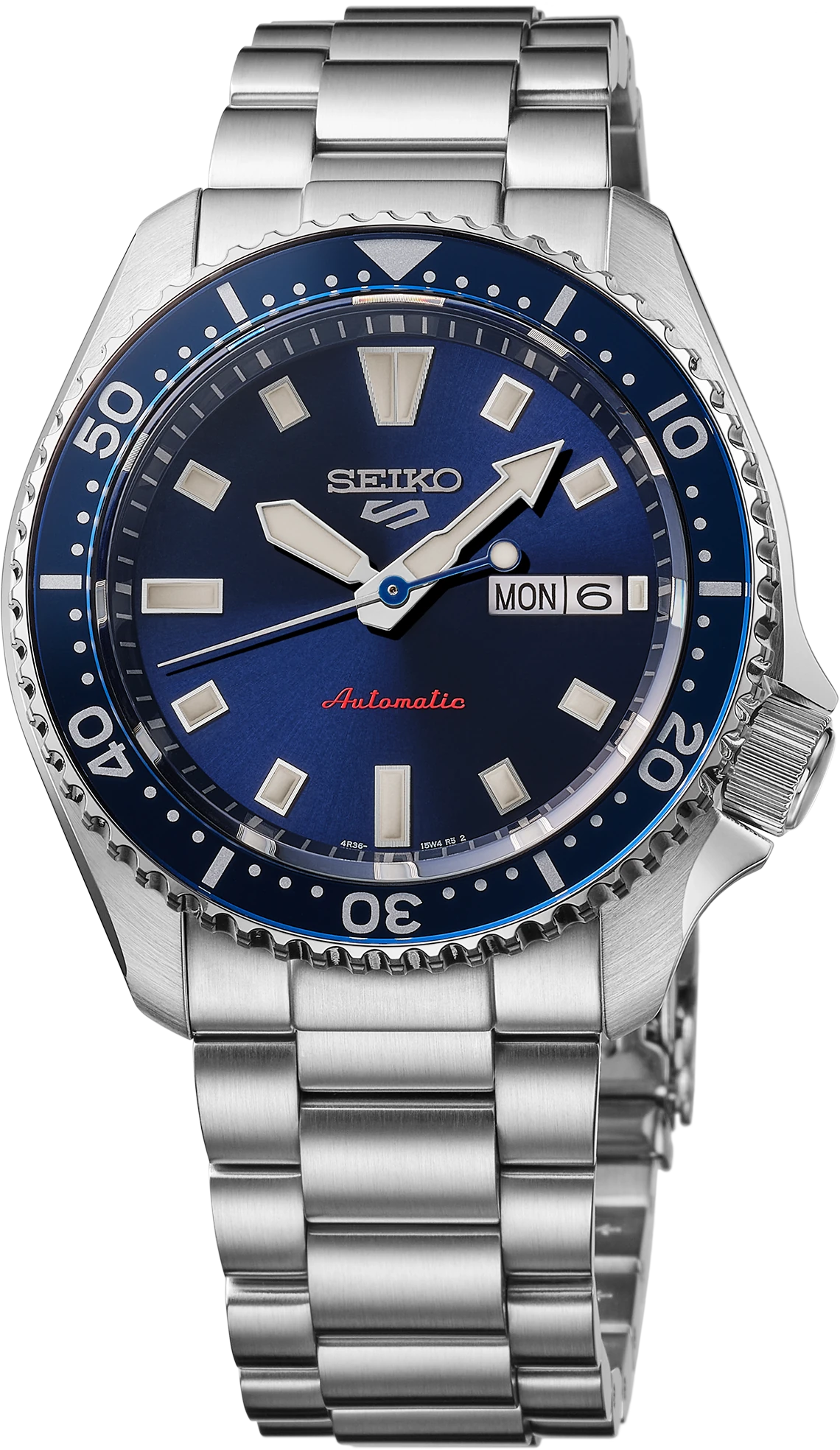
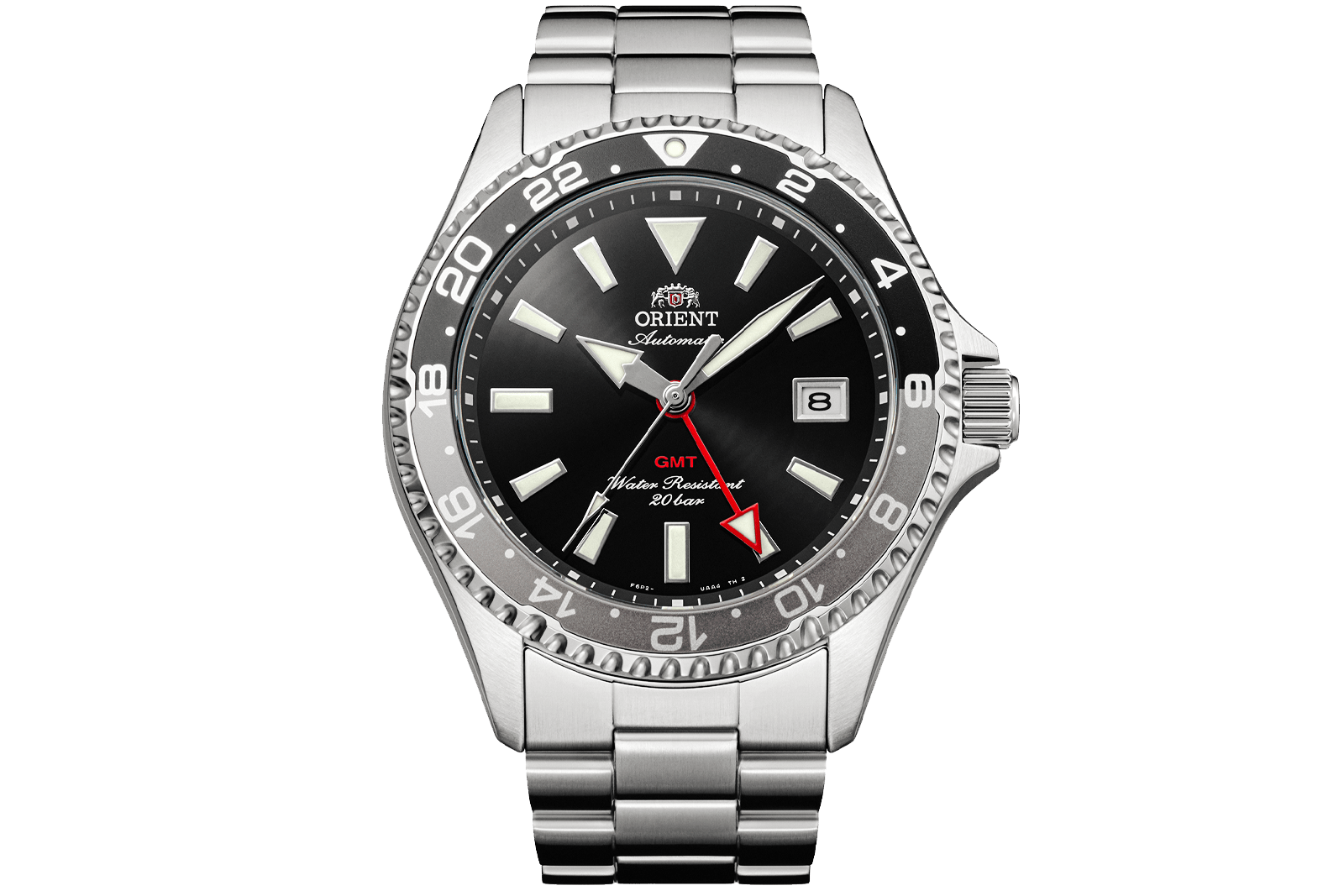
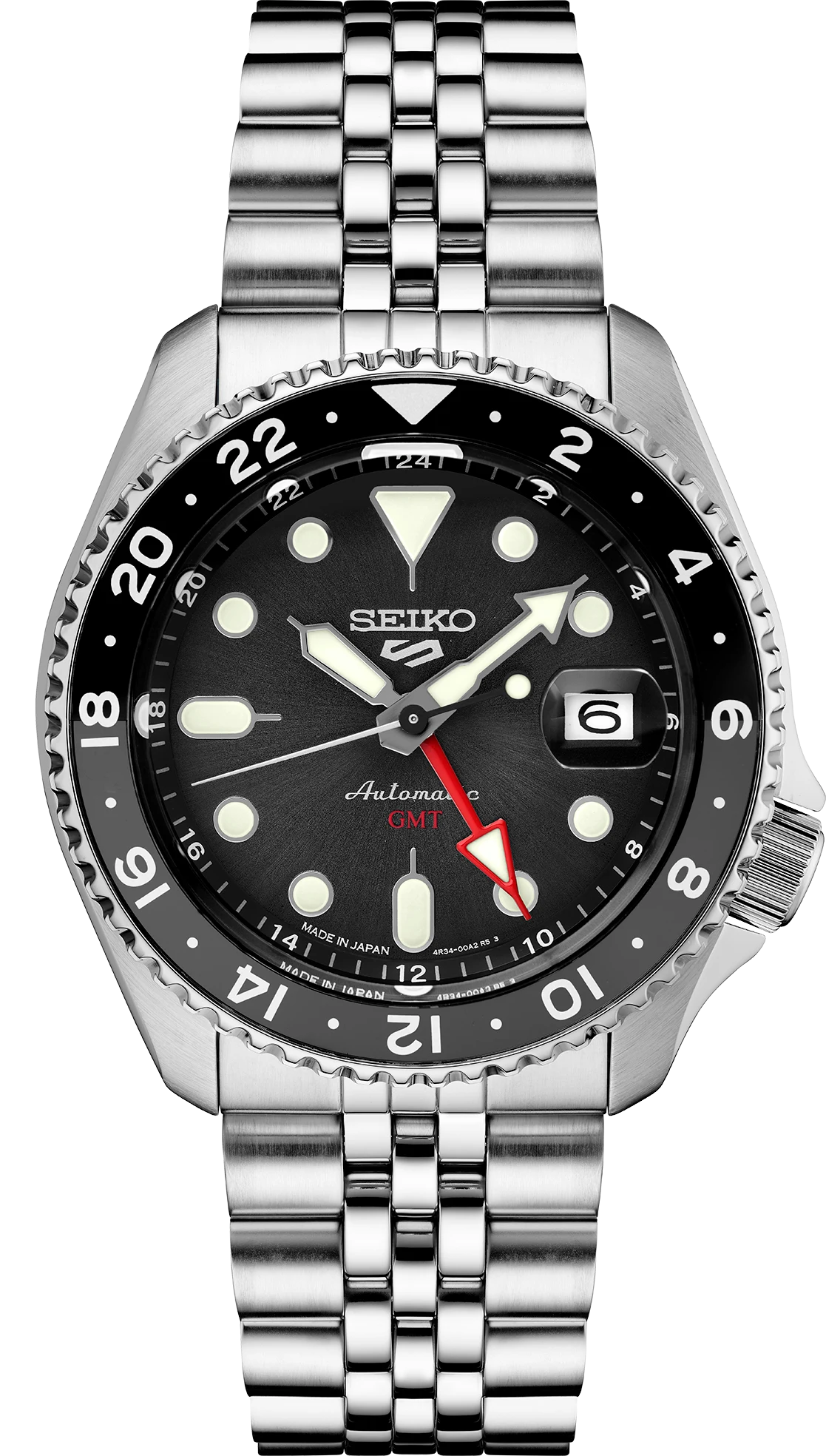
The black Kamasu GMT RA-BC0001B30B is $495 at Orient Watch USA, the same price as the blue RA-BC0003L30B in our spec table and the other two standard colors. Seiko charges $495 for the SSK001 on its own US store. Two Japanese automatics with 24-hour bezels, both on steel bracelets, at exactly the same money. That makes this one of the rare comparisons where price drops out and the spec sheets have to do all the arguing.
They argue in different directions.
| OrientKamasu GMT | Seiko5 Sports SKX GMT | |
|---|---|---|
| Price (US) | $495 | $495 |
| Reference | RA-BC0003L30B | SSK001 |
| Movement | Orient F6P22, automatic | Seiko 4R34, automatic |
| Power reserve | About 40 hours | About 41 hours |
| Rated accuracy | +25/−15 sec/day (edge) | +45/−35 sec/day |
| Hacking / hand-winding | Yes / Yes | Yes / Yes |
| Jewels | 22 | 24 |
| Beat rate | 21,600 vph | 21,600 vph |
| Case diameter | 42.8mm | 42.5mm |
| Thickness | 13.4mm | 13.6mm |
| Lug to lug | 49.5mm | 46mm (edge) |
| Lug width | 22mm | 22mm |
| Crystal | Sapphire (edge) | Hardlex, magnifier over the date |
| Caseback | Not published | Exhibition, screw-down |
| Water resistance | 200m (edge) | 100m |
| Bezel | Unidirectional 120-click, 24-hour scale | Rotating, two-tone 24-hour scale |
| Crown | Screw-down (edge) | Not listed as screw-down |
| Lume | Hands and markers | LumiBrite on hands and indices |
| Bracelet / strap | Steel bracelet, solid end links, fold-over clasp with safety | Five-row steel bracelet, three-fold clasp with push-button release |
| Warranty | 3 years (Orient Watch USA) | 3 years (Seiko USA, purchases on or after July 1, 2024) |
What does each 24-hour hand actually do?
This is the row that decides the comparison for a frequent flyer, so it goes first.
Seiko’s manual for the 4R34 caliber tells owners to pull the crown to the first click and turn it clockwise to move the 24-hour hand on its own, while the seconds hand keeps running. The manual then walks through using the watch “in the case of 24-hour hand being set to different time zone”. Set the hour hand to local time, set the 24-hour hand to home, and the bezel can track a third zone. In watch-trade shorthand this is an office or caller GMT, where the 24-hour hand moves independently and the hour hand stays where it is.
Orient‘s caliber F6P22 works differently. Epson, which owns Orient and publishes the movement’s user guide, states in a boxed caution that the 24-hour hand is synchronized with the hour and minute hands and cannot be adjusted on its own. The hand shows the current time on a 24-hour scale. A second zone comes from turning the bezel to the time difference and reading the 24-hour hand against it. We covered that in detail in our Kamasu GMT profile.
Counted plainly, the Seiko can show three zones at once (hour hand, 24-hour hand, bezel). The Orient can show two (hour hand, and the 24-hour hand read against the bezel). The Seiko takes this round, and it is the one function the word GMT promises.
Price
Both are $495. Neither maker charges extra for a color, and the Kamasu GMT comes in black, green, blue and orange at that price. A limited blue edition, RA-BC0005L30B, is $545 at Orient Watch USA and is not part of this comparison.
What the money builds, row by row
With the price equal, we worked out what each dollar buys in the one specification that most separates these two cases.
| Our calculation | Kamasu GMT | Seiko 5 Sports GMT |
|---|---|---|
| Price | $495 | $495 |
| Rated water resistance | 200m | 100m (10 bar) |
| Price per meter of rated depth | $2.48 | $4.95 |
| Crystal | Sapphire | Hardlex |
| Crown | Screw-down | Not listed as screw-down |
Our inputs are the Orient Watch USA and Seiko US product pages, read November 9, 2026, with price divided by rated depth and rounded to the cent.
Price per meter is a crude measure, and nobody needs 200m for a flight. But it captures how much more case the Orient puts around the movement for the same money. A screw-down crown is a large part of that. Orient lists one on the Kamasu GMT. Seiko lists screw-down crowns among the features of its Prospex divers, and does not list one for the SSK001.
Movement
Both calibers are made in-house by their parent groups, beat at 21,600 vibrations per hour, hack (the seconds hand stops when you pull the crown to set the time) and wind by hand.
The F6P22 runs for more than 40 hours, per Epson. The 4R34 runs for about 41 hours, per Seiko. Call that even.
Accuracy is not even. Epson rates the F6P22 at +25 to −15 seconds a day. Seiko rates the 4R34 at +45 to −35 seconds a day, worn on the wrist between 5°C and 35°C. On a 10-day trip at the worst end of each spec, the Orient could be 4 minutes 10 seconds fast and the Seiko 7 minutes 30 seconds fast. Individual watches often run inside their limits, but the published tolerance is the one a buyer can hold the maker to, and it is tighter on the Orient. Our accuracy ratings explainer covers how those numbers are measured.
Case and Dimensions
The Kamasu GMT measures 42.8mm across, 13.4mm thick and 49.5mm lug to lug, with 22mm lugs. The Seiko measures 42.5mm across, 13.6mm thick and 46mm lug to lug, also with 22mm lugs.
Diameter and thickness are a wash. Lug to lug, the distance from the tip of the top lugs to the tip of the bottom ones, is not. The Seiko is 3.5mm shorter, and that is the number that decides whether a watch overhangs a smaller wrist. The Seiko takes this row.
The Seiko also has a screw-down exhibition caseback, so the 4R34 is on show. Orient’s product page does not describe the Kamasu GMT’s caseback, so we leave that row out.
Dial and Bezel
Side by side in black, the two look closely related. Each has a black dial, a red-tipped 24-hour hand, a two-tone black and grey bezel with a 24-hour scale and a date at 3.
The differences are in the detail. Seiko puts a magnifier over the date, which some buyers like and some do not. Orient’s bezel is a 120-click unidirectional design, and Seiko describes its own simply as a rotating 24-hour bezel. Both use luminous hands and markers, with Seiko naming its compound as LumiBrite.
Crystal
Sapphire on the Orient, Hardlex on the Seiko. Hardlex is Seiko’s own hardened mineral glass. It is tougher than ordinary mineral crystal, but sapphire is harder again and is the material most likely to shrug off the desk-edge scrapes that collect on a daily watch. The Orient takes this row clearly, and our explainer on where sapphire crystals start shows how rare it is at $495.
Water Resistance
200m against 100m. Neither is sold as an ISO 6425 diver’s watch, and Orient’s global site says so in a footnote for the Kamasu GMT. Both ratings comfortably cover swimming. The Orient’s case, crown included, is simply specified for more.
On the Wrist
On paper, these will wear at a similar height and width. The Seiko’s 46mm lug to lug makes it the easier fit on a smaller wrist, where the Orient’s extra 3.5mm is more likely to reach the edges. Weight favors neither in a way we can verify, because Orient does not publish one for the GMT. Seiko lists 161 grams.
Long-Term Ownership
Both come with three-year warranties in the US, Orient through Orient Watch USA and Seiko for watches bought from Seiko USA or its dealers on or after July 1, 2024. Seiko lists the SSK001’s magnetic resistance as 4,800 A/m, and Epson puts the F6P22 in the same basic Type 1 class.
A sapphire crystal is the part most likely to still look new in five years. A Hardlex crystal is replaceable, but it is the more likely of the two to need replacing.
Value
At equal money, the Kamasu GMT gives more watch in the material sense. Sapphire, a 200m case, a screw-down crown and a tighter rate spec. The Seiko gives more GMT. Its independent 24-hour hand is a genuine functional advantage that no amount of case engineering on the Orient can match. It also has a display back and a shorter case.
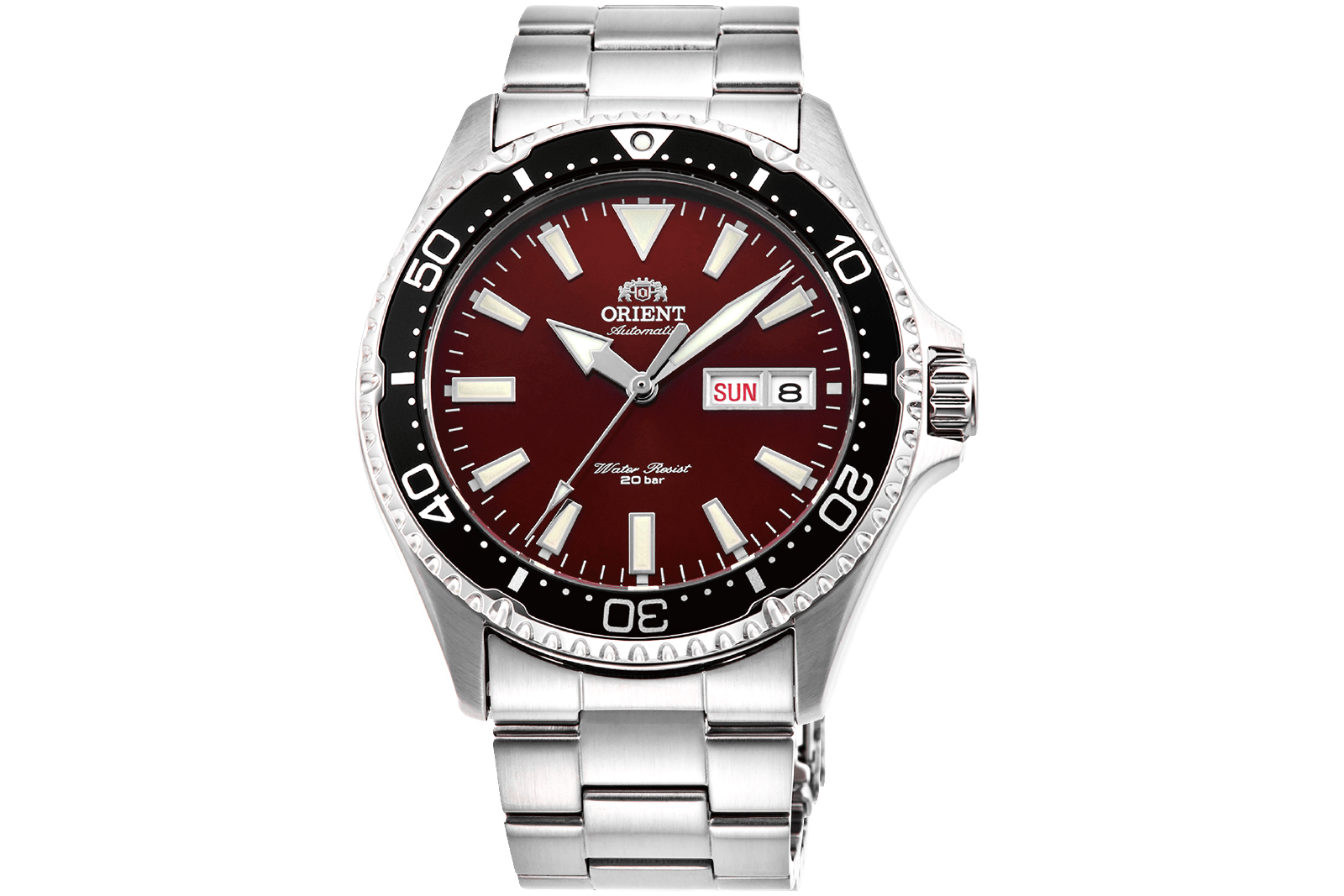
For the Kamasu GMT’s place in Orient’s wider line, see our Kamasu vs. Seiko 5 Sports comparison, which covers the standard three-hand Kamasu.
Verdict
- Best Build
- Orient Kamasu GMT
- Best GMT Function
- Seiko 5 Sports SKX GMT
- Best Value
- Orient Kamasu GMT
- Editor’s Pick
- Orient Kamasu GMT
Buy the Seiko 5 Sports GMT if you cross time zones often and want a hand that sits on home time while the hour hand moves to local. That is the core GMT job, and the SSK001 does it better at $495.
For everyone else, and that is most people buying a $495 watch with a 24-hour bezel, the Orient Kamasu GMT is our pick. It is the better-built watch on every measurable row except length, with sapphire, 200m, a screw-down crown and an accuracy spec that is 20 seconds a day tighter at the fast end. The next thing to watch is Orient’s catalog. A Kamasu GMT with an independently set 24-hour hand at this price would settle the question outright.