At the edge of its rating, an affordable automatic can drift between about 6 and 22 minutes a month, depending on whose movement it is. That is our arithmetic from the makers’ own published tolerances, and it is the clearest way we know to compare numbers that are usually printed as seconds a day and then forgotten.
An accuracy rating is the range of daily error a maker is prepared to publish for a movement. Orient rates its F6922 at +25 to −15 seconds a day. That means a new watch running within specification might gain up to 25 seconds in a day or lose up to 15. The rating says nothing about which end of the range a particular watch will sit at.
Our conversion
We took each rating and used its larger side, the worst case, and multiplied it out. If a watch sat at that edge every day, how far off would it be after a week and after 30 days, and how many days would it take to be a full minute out? Here is the result for the current movements in our coverage that have a published rating.
| Movement | Found in | Published rating (sec/day) | Conditions the maker states | Worst case per week | Worst case per 30 days | Days to drift one minute |
|---|---|---|---|---|---|---|
| Seiko 4R35, 4R36 | Seiko 5 Sports, Presage, Prospex SRPF03 | +45/−35 | Worn on the wrist at 5°C to 35°C, factory-adjusted | 5 min 15 sec | 22 min 30 sec | 1.3 |
| Miyota 8215 | Timex Marlin Automatic | −20/+40 | Not stated | 4 min 40 sec | 20 min | 1.5 |
| Orient F6922, F6724, F6722 | Orient Kamasu, Bambino, Stretto | +25/−15 | Not stated on the product pages | 2 min 55 sec | 12 min 30 sec | 2.4 |
| Seiko 6R35 | Seiko Prospex SPB177 | +25/−15 | Worn on the wrist at 5°C to 35°C, factory-adjusted | 2 min 55 sec | 12 min 30 sec | 2.4 |
| Seiko 6R55 | Seiko Prospex Alpinist SPB507 | +25/−15 | Not stated on the product page | 2 min 55 sec | 12 min 30 sec | 2.4 |
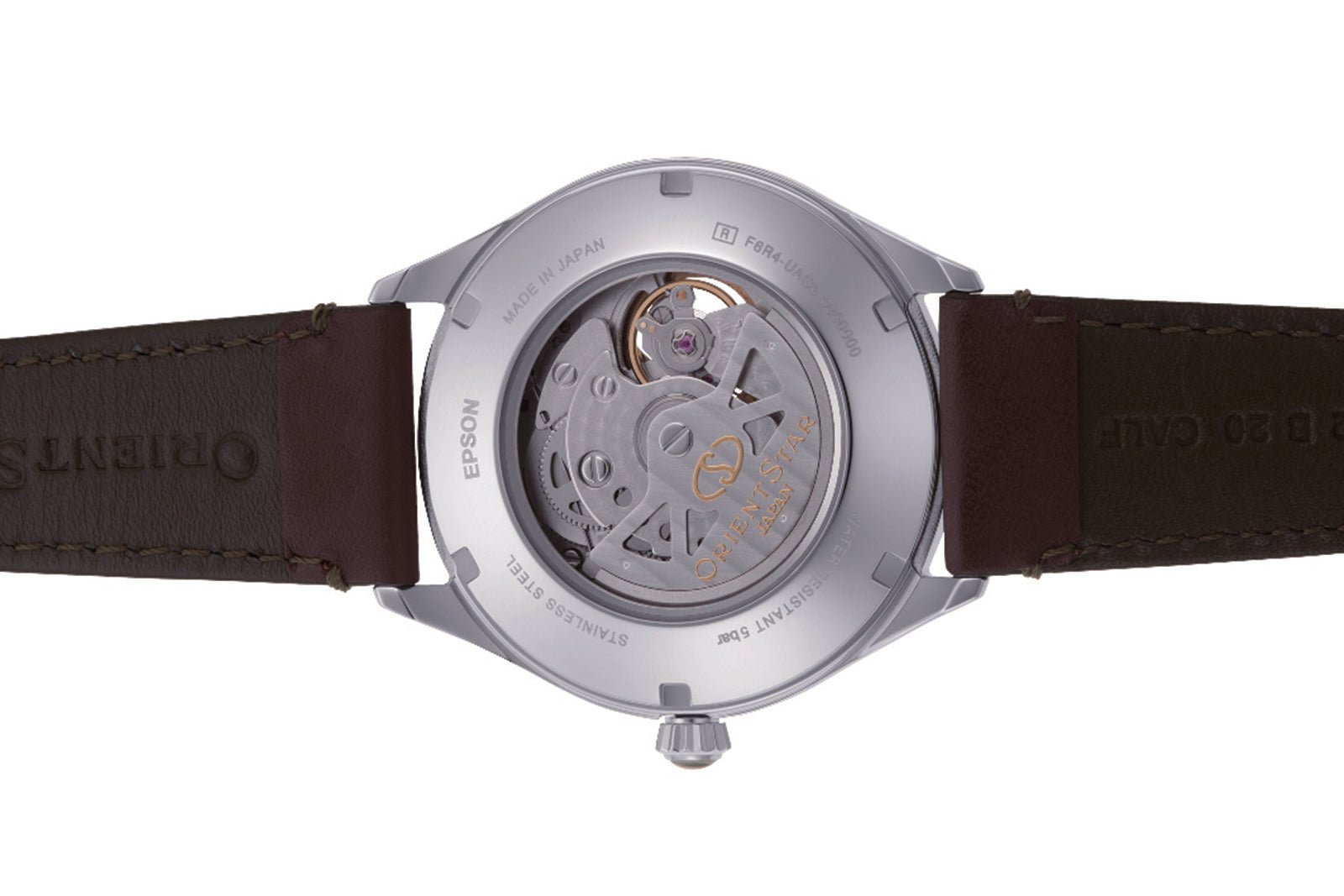
| Orient Star F8N64 | Orient Star M34 F8 Date | +15/−5 | Not stated on the product page | 1 min 45 sec | 7 min 30 sec | 4 |
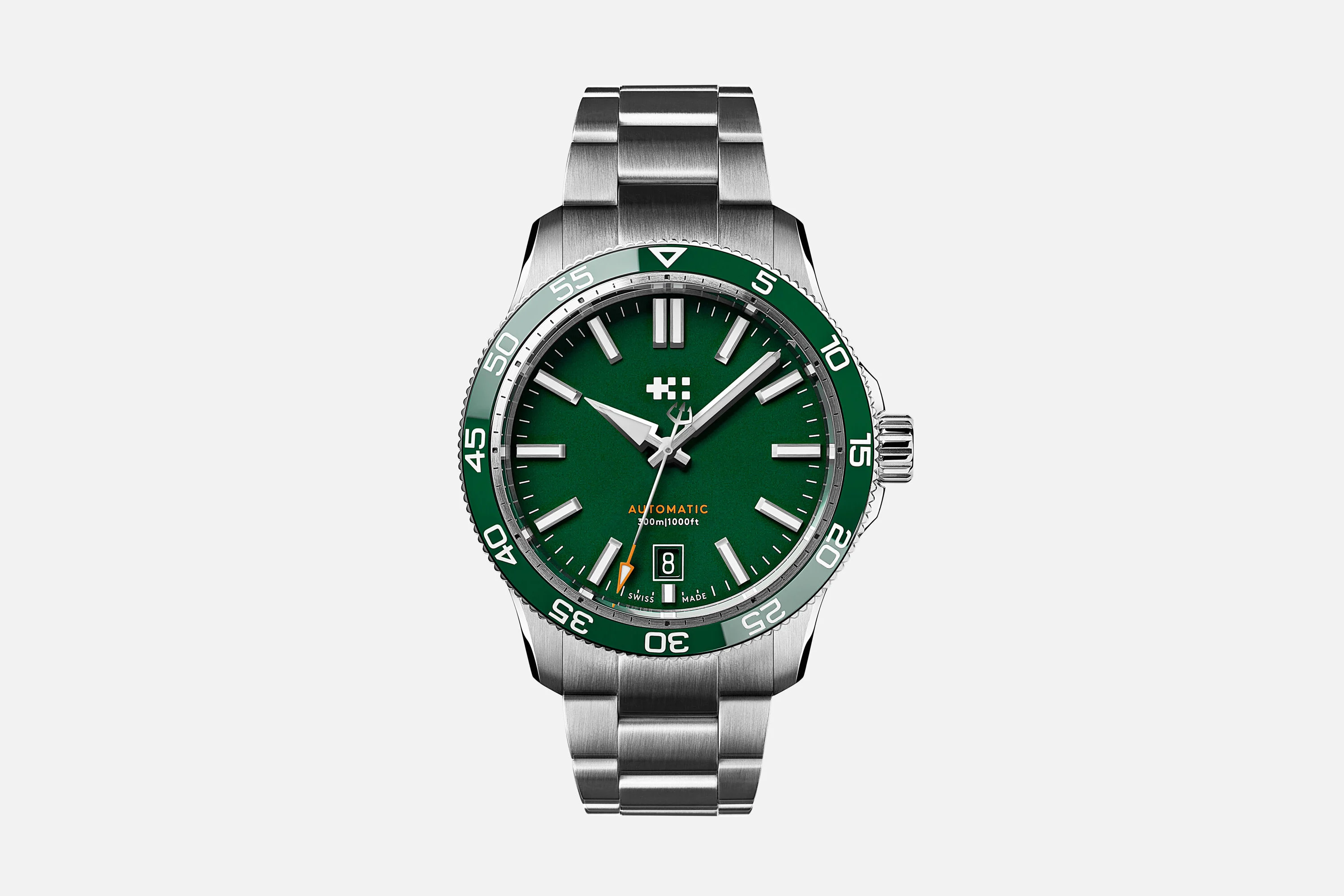
| Sellita SW200-1 | Christopher Ward C60 Trident Pro 300 | −5/+12 | Listed as timing tolerance | 1 min 24 sec | 6 min | 5 |
| Grand Seiko 9S64 | Grand Seiko SBGW325 | +5/−3 | Static, measured off the wrist | 35 sec | 2 min 30 sec | 12 |
| Orient VS752 (solar quartz) | Orient TX02 Solar Chronograph | ±20 sec/month | Not stated | About 5 sec | 20 sec | About 90 |
| Citizen A060 (Eco-Drive quartz) | THE CITIZEN Tosa washi editions | ±5 sec/year | Not stated | Under 1 sec | Under 1 sec | About 12 years |
The quartz rows are there for scale. A light-powered quartz chronograph rated at ±20 seconds a month takes about three months to drift as far as a Seiko 4R at the edge of its rating drifts in a day and a third.
What the numbers say
The mechanical rows fall into three groups.
The widest is the +45/−35 of Seiko’s 4R calibers and the −20/+40 of the Miyota 8215 in the Timex. At the edge of those ratings a watch can be about 20 minutes out after a month. In practice nobody lets it get that far. It means resetting the watch every few days if you care about the minute.
The middle group is +25/−15. It includes Orient’s F6 family, which powers almost every mechanical Orient under $400, and Seiko’s 6R35 and 6R55, which cost $900 in the Prospex SPB177 and Alpinist SPB507. On paper, Orient promises the same tolerance as Seiko’s next tier up, at well under half the price. The Kamasu, for example, is $375 at Orient Watch USA. That is a real advantage for Orient over Seiko’s 4R watches, and it is the kind of detail that shows up only when you put the ratings side by side.
The tightest affordable group is the Sellita SW200-1 at −5/+12 and Orient Star’s F8N64 at +15/−5. Both stay inside eight minutes a month at the edge of their ratings. Grand Seiko‘s 9S64, at $5,800 in the SBGW325, is in the table to show what a top-tier rating looks like. Its +5/−3 works out to two and a half minutes a month at worst.
A rating is a promise about the worst case, not a forecast. The useful question is how wide a promise the maker is willing to print.
The fine print changes the comparison
The conditions column matters more than it looks. Seiko says its 4R35, 4R36 and 6R35 ratings apply only when the watch is worn on the wrist at 5°C to 35°C, and that the figures are factory-adjusted. Grand Seiko’s 9S64 rating is static, measured with the watch off the wrist. Christopher Ward calls its figure a timing tolerance. Orient, Timex and Orient Star give the number without stating the conditions on the pages we checked.
So these ratings are not measured the same way, and the table is a comparison of what each maker is willing to publish rather than a laboratory result. It is still the best like-for-like information a buyer has.
Seiko’s instructions add two more pieces of fine print that apply to every mechanical watch. First, the rate should be judged over about a week, not a single day. Second, it moves with conditions. Seiko says a mechanical watch tends to lose time at high temperatures and gain at low ones, and that the rate depends on position, how long the watch is worn and how fully the mainspring is wound. A watch that sits at +10 on the wrist might behave differently on a nightstand.
Every rating allows more gain than loss
Look along the published ratings and a pattern appears. Each one allows more gain than loss, +45 against −35, +40 against −20, +25 against −15, +12 against −5. The makers do not explain the choice on the pages we read, but the practical effect is plain. A watch at the edge of its rating will be early rather than late.
Who publishes nothing
The table leaves out some good movements because their makers do not print a rating on the pages we checked. Hamilton gives no figure for the H-10 in the Khaki Navy Scuba or for the hand-wound H-50 in the Khaki Field Mechanical. Tissot gives none for the Powermatic 80 in the PRX. Citizen’s US product pages for the Tsuyosa and the Promaster Dive Automatic do not list one for the 8210 or 8204 either.
A missing figure does not mean a poor movement. Hamilton says the Nivachron balance spring in the H-10 reduces the effects of magnetism, temperature and shocks. It does mean you are buying the timekeeping on trust, and that the watches with published numbers are the only ones you can hold to them.
What to do with this
If you wear one mechanical watch and set it once a week, any rating in our table is workable. If you want to set it once a month and still be within a few minutes, the tight end of the table is where to look, and Orient’s F6 rating puts it closer to that end than its price suggests.
The more useful habit is to find your own watch’s rate. Note the error against a reliable time source, wait a week, check it again, and divide by seven. That number tells you more than any spec sheet, because it is yours. For the other numbers on the sheet, see our guide to reading a watch spec sheet, and for the case for quartz accuracy, Seven Watches That Make a Strong Case Against Quartz.