


The integrated bracelet, where the case flows directly into the links with no visible lugs, has been one of the defining shapes in watches for years. At the top of the market it is very expensive. Lower down, the Tissot PRX made it accessible. The Tsuyosa goes further still, putting the look into a Citizen automatic that lists at $495.
This review covers the black-dial NJ0150-56E. The Tsuyosa has also been offered in other dial colors, and WatchTime has listed blue, yellow, green and turquoise versions alongside the black.
| Price (US) | $495 |
|---|---|
| Reference | NJ0150-56E |
| Movement | Citizen 8210, automatic |
| Power reserve | About 42 hours |
| Rated accuracy | +40/−20 sec/day (82xx family rating) |
| Hacking / hand-winding | Yes / Yes |
| Jewels | 21 |
| Beat rate | 21,600 vph |
| Functions | Hours, minutes, seconds, magnified date |
| Case diameter | 40mm |
| Case material | Stainless steel |
| Crystal | Sapphire |
| Caseback | Exhibition (mineral glass) |
| Water resistance | 50m |
| Dial | Black sunray |
| Bracelet / strap | Integrated steel bracelet, push-button fold-over clasp |
| Warranty | 5 years (Citizen USA) |
Price
Citizen USA sells the NJ0150-56E for $495. That puts it well below the $850 Tissot PRX Powermatic 80, and $120 above the Orient Kamasu, which is $375 at Orient Watch USA with a sapphire crystal and 200m of water resistance.
Citizen’s warranty adds to the value. Five years is the longest offered on any watch in our under-$500 guide, where the Tsuyosa is our pick for an integrated bracelet. Orient offers three years. Tissot offers two.
Design
The case is 40mm across in stainless steel, and it flows into an integrated three-link bracelet that closes with a push-button fold-over clasp. WatchTime describes the bracelet links as brushed on the sides with polished center links, and the case as chamfered and finished with both brushing and polishing. That mix of surfaces is what gives an integrated design its character, and it is good to see it at this price.
The dial is black with a sunray finish, which Citizen pairs with an anti-reflective sapphire crystal. The date sits at 3 o’clock under a magnifier. A cyclops is practical, making the date easy to read, but it is also divisive. Some buyers will see it as a useful feature, others as an interruption on an otherwise clean crystal. It is worth deciding which camp you are in before buying.
The integrated design has one practical consequence. Because the bracelet is shaped to the case, you cannot easily swap it for a strap the way you can on a watch with conventional lugs. If you like changing straps, a watch like the Kamasu is more flexible.
Movement
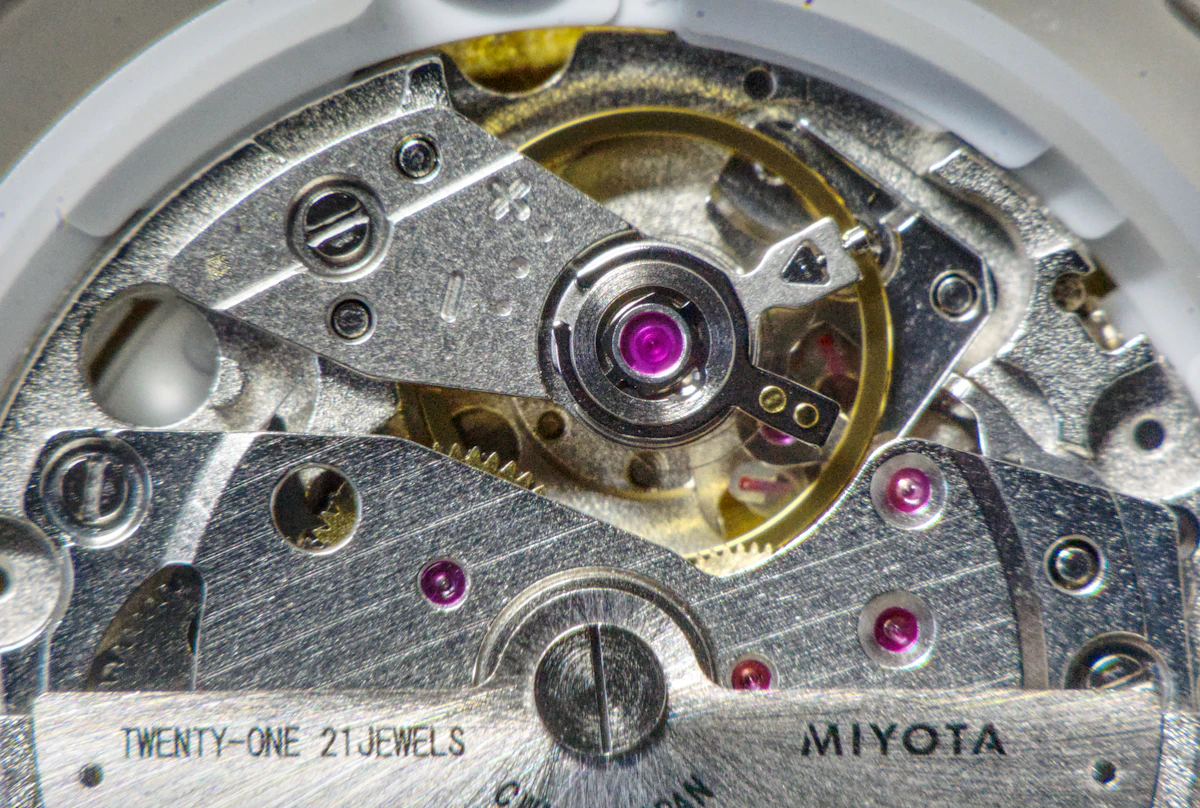
Inside is Citizen’s caliber 8210, an automatic with 21 jewels running at 21,600 vph. Citizen quotes a power reserve of about 42 hours, and its product page confirms the movement hacks. It also hand-winds, so you can top it up through the crown.
Citizen rates its 82xx family at −20/+40 seconds a day. That is a wide tolerance, narrower than the Seiko 4R family’s +45/−35 but wider than Orient’s +25/−15 for the F6922 in the Kamasu. As with all factory ratings, it sets a limit rather than predicting how a given watch will run. Our guide to spec sheets explains how to read those numbers.
The movement is visible through an exhibition caseback glazed in mineral glass rather than sapphire. That is a small economy, and a reasonable one at this price, since the caseback faces the wrist rather than the world.
Case and water resistance
Water resistance is 50m, which Citizen describes as suitable for still-water swimming. That is adequate for daily wear and the occasional swim, but it is the Tsuyosa’s clearest weakness against both rivals. The PRX is rated to 100m and the Kamasu to 200m, with a screw-down crown.
Citizen does not publish a case thickness for the Tsuyosa. WatchTime has reported it at 11.7mm, which would make it a little thicker than the PRX at 10.93mm and a little thinner than the Kamasu at 12.8mm. Citizen also does not publish a lug-to-lug figure, though on an integrated design the first bracelet link effectively sets the watch’s length on the wrist.
Against the Tissot PRX
The PRX Powermatic 80 is the obvious comparison, since it is the watch most people think of when they think of an affordable integrated bracelet. It costs $850, more than twice the Tsuyosa’s recent selling price.
For that money, the Tissot offers a much longer reserve, 80 hours against about 42, from the Powermatic 80.111 with its Nivachron hairspring. It doubles the water resistance to 100m, and at 10.93mm its published thickness is slimmer than the figure reported for the Citizen. Both have sapphire crystals and see-through casebacks.
The Citizen answers with price and warranty. It costs less than half as much at its recent price, and its five-year warranty is two and a half times the length of Tissot’s two.
If the long reserve and extra water resistance matter, the PRX is worth the extra money. If you want the shape and the general specification and would rather keep the savings, the Tsuyosa is the sensible choice. Tissot’s new PRX Quartz Chronograph, at $525, is another way into the PRX design if you do not need a mechanical movement.
Against the Orient Kamasu
The Kamasu is not an integrated-bracelet watch. It is a dive watch on an oyster-style bracelet, and it is here because it costs almost exactly what the Tsuyosa does. At $375, it is the obvious alternative for a buyer with this budget who is open to a different style.
On paper, the Kamasu is better specified. It matches the Tsuyosa’s sapphire crystal and adds 200m of water resistance against 50m, a screw-down crown, a 120-click unidirectional bezel and a day-date. Orient’s accuracy rating of +25/−15 seconds a day is tighter than Citizen’s. The reserves are close, about 40 hours against about 42.
The Tsuyosa wins on warranty, five years against three, and it offers an exhibition caseback where the Kamasu has a solid one. And it simply offers a different look. The Kamasu is a 41.8mm sports diver. The Tsuyosa is a 40mm integrated design with a dressier, more urban look. Our Kamasu review covers the Orient in detail.
The Tsuyosa is not the most capable watch at its price. It is the most affordable way to buy this particular shape with sapphire and a long warranty.
Who should buy it
The Tsuyosa suits a buyer who wants an integrated-bracelet watch and does not want to pay PRX money for it. It is well specified where it counts most for daily wear, with a sapphire crystal, a hacking automatic and a five-year warranty, and the bracelet design gives it a character that most sub-$500 automatics lack.
It suits a swimmer or diver less well, at 50m, and it suits anyone who wants a long reserve less well, at about 42 hours. Buyers who dislike a date magnifier should look at the PRX instead.
Verdict
The Tsuyosa delivers on its premise. It brings the integrated-bracelet design into a price band where it was once rare, and it does so without cutting the corners that matter most. Sapphire, hacking, an exhibition caseback and a five-year warranty are all present at $495.
It is not perfect. The water resistance is modest, the reserve ordinary and the accuracy tolerance wide, and the PRX is the stronger watch for those who can spend the extra. But for most buyers who want this shape at this price, the Tsuyosa is the one to buy, and it earns its place in our guide to the best automatics under $500.


