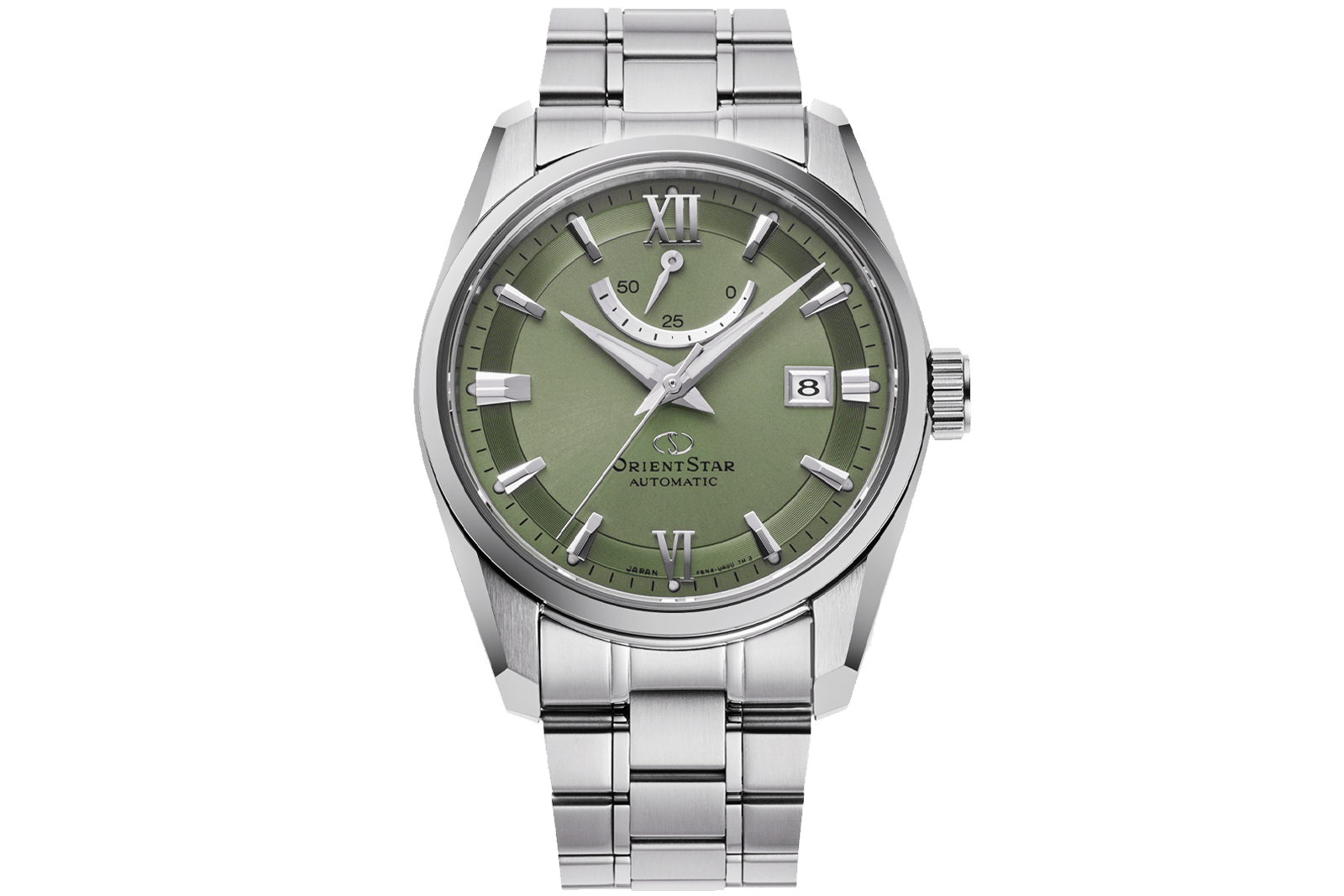
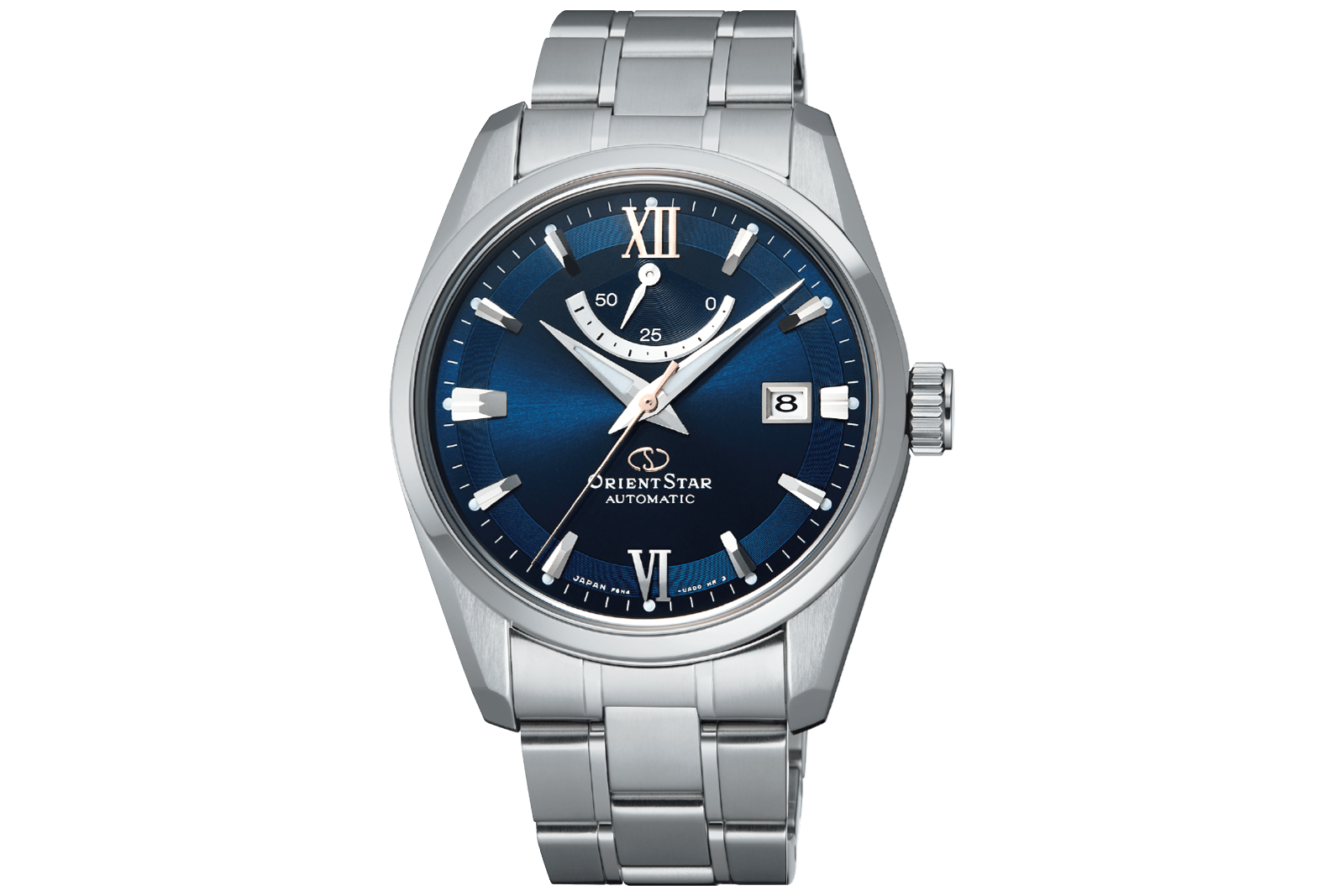
Orient Star is the line above Orient, launched in 1951. Every Orient Star reference listed by Orient Watch USA on November 9, 2026 had a power reserve indicator. The Contemporary Index, reference RE-AU0005L00B, is $560 at Orient Watch USA. It is a 38.5mm steel watch on a bracelet with a blue dial, an anti-reflective sapphire crystal and a display back.
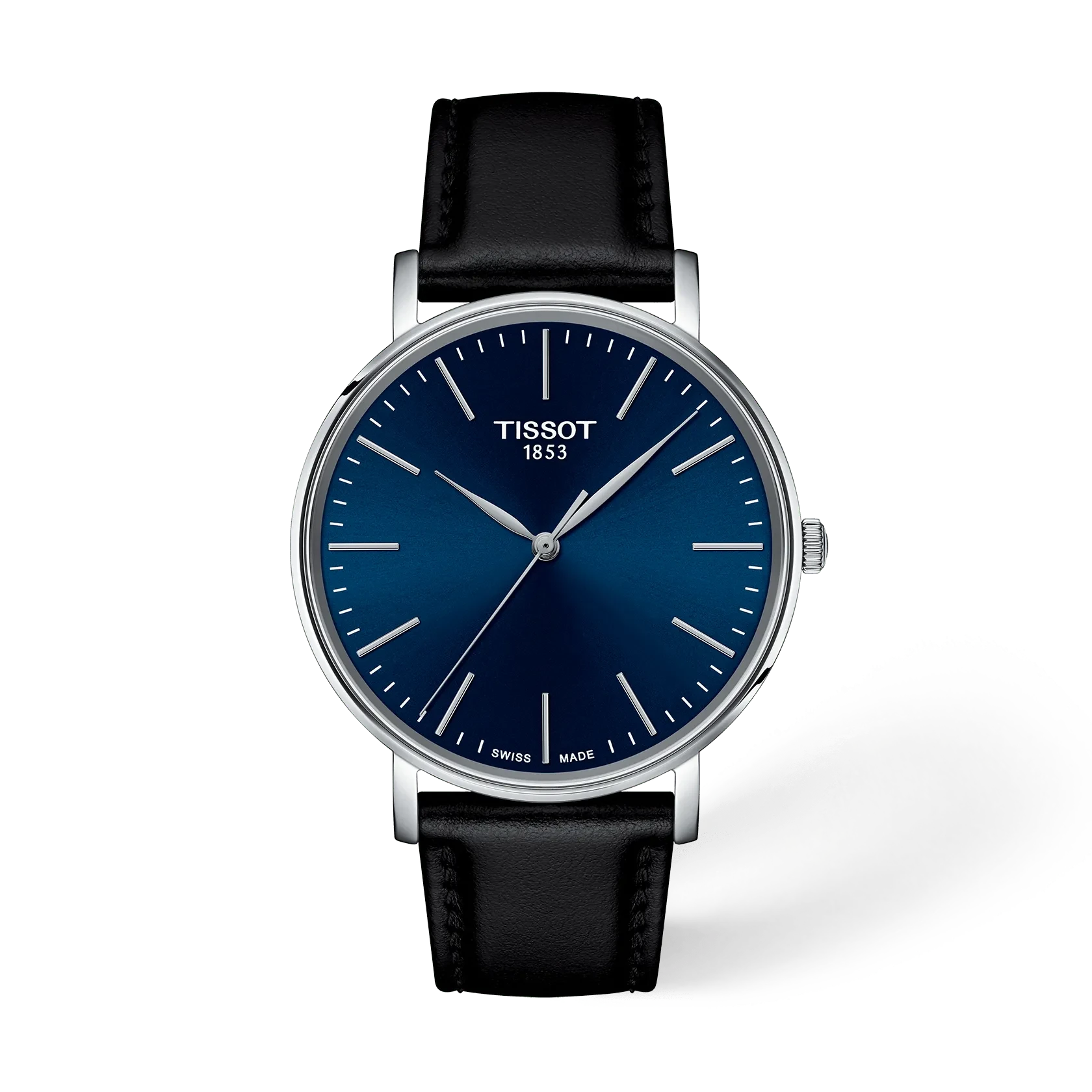
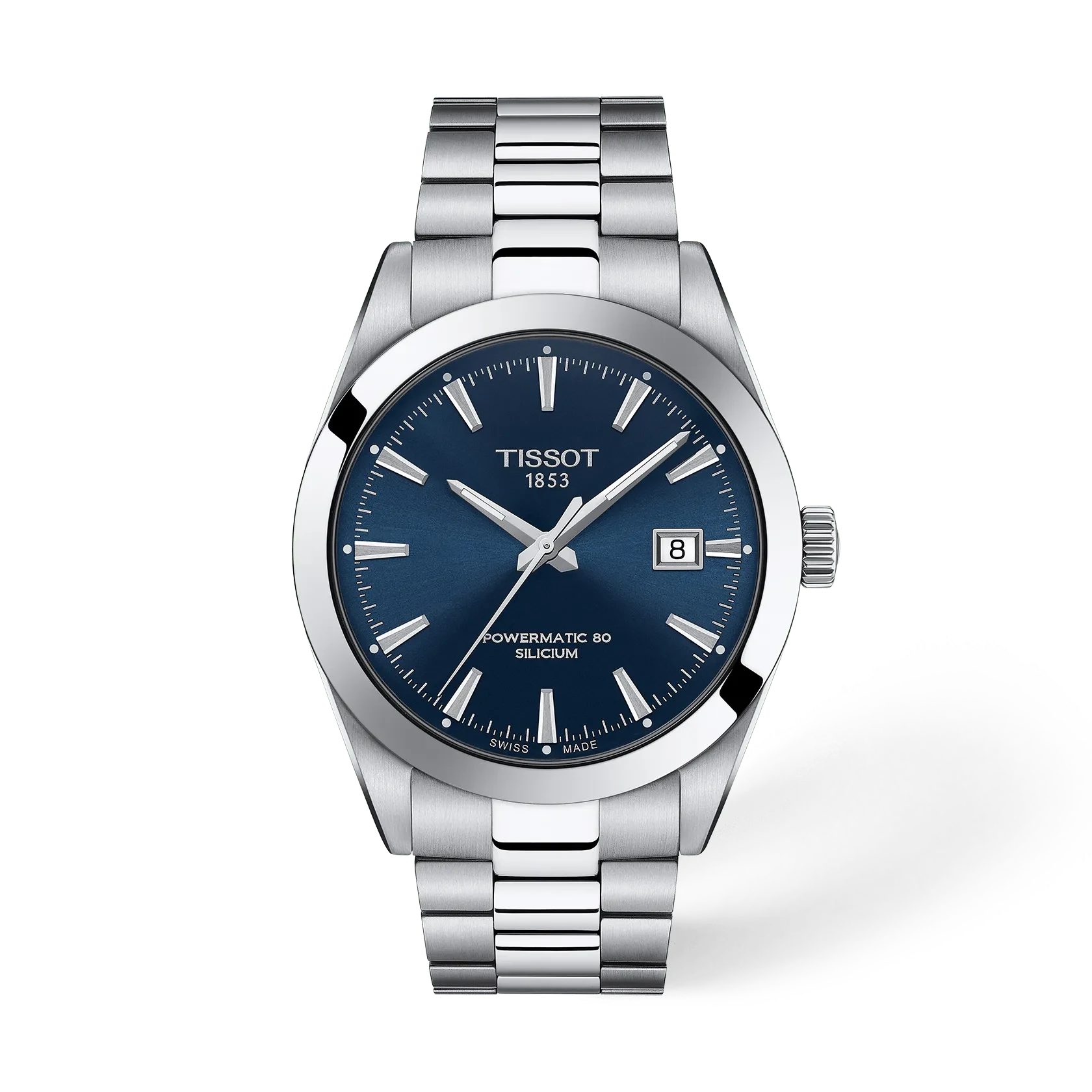
Tissot’s Gentleman Powermatic 80 Silicium in blue, T127.407.11.041.00, is $950 on Tissot’s US store. It is a 40mm steel watch on a bracelet with a blue dial, an anti-reflective sapphire crystal and a display back.
Read those two paragraphs again and the overlap is plain. The question is what $390 changes.
| OrientStar Contemporary Index | TissotGentleman Powermatic 80 Silicium | |
|---|---|---|
| Price (US) | $560 (edge) | $950 |
| Reference | RE-AU0005L00B | T127.407.11.041.00 |
| Movement | Orient Star F6N43, automatic | Powermatic 80 (silicon balance spring), automatic |
| Power reserve | About 50 hours, with indicator | 80 hours (edge) |
| Rated accuracy | +25/−15 sec/day (edge) | Not published |
| Hacking / hand-winding | Yes / Yes | Not published |
| Jewels | 22 | Not published |
| Beat rate | 21,600 vph | Not published |
| Case diameter | 38.5mm | 40mm |
| Thickness | 12.3mm | 11.5mm (edge) |
| Lug to lug | 46.9mm | Not published |
| Lug width | 20mm | 21mm |
| Crystal | Sapphire, anti-reflective coating | Sapphire, anti-reflective coating on the underside |
| Caseback | Exhibition | Exhibition |
| Water resistance | 50m (RE-AU0004B00B: 100m) | 100m (edge) |
| Bracelet / strap | Steel bracelet | Steel bracelet |
| Warranty | 3 years (Orient Watch USA) (edge) | 2 years (Tissot) |
Movement
The Tissot’s strongest ground, so it comes first. Tissot gives the Powermatic 80 a reserve of 80 hours, and this version uses what Tissot calls a patented silicon balance spring. Tissot says silicon gives “far greater resistance to the magnetic fields produced by everyday objects”. Tissot does not publish an accuracy figure for the movement on this page.
The Orient Star’s caliber F6N43 is an in-house movement from Epson, which owns Orient. Epson’s user guide gives a minimum of 50 hours, 21,600 vibrations per hour, Type 1 magnetic resistance and a daily rate of +25 to −15 seconds, measured static at the factory. It hacks and winds by hand, and the indicator at 12 shows how much of the 50 hours remains.
On reserve and on the hairspring, the Tissot wins outright. On published accuracy, the Orient wins by default, because only Orient gives a number. Our guide to reading a watch spec sheet explains why a missing rate matters.
What does each hour of reserve cost?
We divided each watch’s price by its rated reserve, and each by its warranty.
| Our calculation | Orient Star Contemporary Index | Tissot Gentleman |
|---|---|---|
| Price | $560 | $950 |
| Power reserve | 50 hours | 80 hours |
| Price per hour of reserve | $11.20 | $11.88 |
| Warranty | 3 years | 2 years |
| Price per year of warranty | $187 | $475 |
Our inputs are the Orient Watch USA, Epson and Tissot US pages, read November 9, 2026. Rounded to the dollar or cent.
The first ratio surprised us. The Tissot’s reserve is 60% longer, but its price is 70% higher, so each hour of reserve costs slightly more on the Swiss watch. The second ratio is not close.
There is still a practical difference the ratio does not capture. A watch taken off at 6 p.m. on Friday runs to about 8 p.m. on Sunday with 50 hours, and to about 2 a.m. on Monday with 80. Only the Tissot survives a full weekend in a drawer, as our power reserve weekend calculation shows. The Orient’s gauge at least tells you when it is about to stop.
Price
$560 against $950, a gap of $390. Orient Watch USA sells the same Contemporary Index in black (RE-AU0004B00B) and silver (RE-AU0006S00B) at $560 as well.
Case and Dimensions
The Orient Star measures 38.5mm across, 12.3mm thick and 46.9mm lug to lug, with 20mm lugs. The Tissot measures 40mm across and 11.5mm thick, with 21mm lugs. Tissot does not publish a lug-to-lug figure.
The Tissot is 0.8mm thinner, which helps under a shirt cuff, and it takes the thickness row. The Orient is 1.5mm narrower. Whether narrower is better depends on the wrist, so we leave diameter unmarked, but a 38.5mm case is the more traditional dress size, as our piece on the return of the 38mm watch argues.
Dial
Both dials are blue. The Orient Star has Roman numerals at 12 and 6, baton markers elsewhere, a date at 3 and the power reserve arc set into the upper half of the dial. The Tissot has a sunray finish, baton markers throughout and a date at 3. The Orient’s dial carries more information. The Tissot’s is the plainer and, some would say, the cleaner of the two.
Crystal
Both have sapphire with anti-reflective treatment. Tissot specifies one coating on the underside of the crystal. Orient Watch USA lists sapphire with an anti-reflective coating and does not say which side. We call this row even.
Water Resistance
The Tissot is rated to 100m and the Orient Star to 50m. Both cover swimming, but the Tissot has more margin and takes the row. The black Contemporary Index, RE-AU0004B00B, is rated to 100m, so a buyer who wants parity has that option at the same price.
On the Wrist
By the numbers, the Orient Star is the smaller watch across the wrist and the Tissot the slimmer one. The Orient’s 46.9mm lug to lug is moderate for a 38.5mm case. With no published length for the Tissot, we cannot say how the two compare end to end.
Quality
The Orient Star comes on a steel bracelet with a fold-over clasp. Tissot specifies 316L stainless steel. Both show their movements through a display back. Neither maker publishes enough about case or movement finishing to rank them, and we have not handled either.
Long-Term Ownership
The warranty gap is the biggest ownership difference on paper. Orient Watch USA gives three years. Tissot gives two. On the Tissot side, the silicon balance spring is designed to reduce one common cause of a mechanical watch suddenly running fast after exposure to magnetism, and that is a lasting advantage. Both crystals are sapphire.
Value
The Orient Star costs 41% less and gives up 30 hours of reserve, the silicon spring, 0.8mm of thickness and 50m of depth. It gains a power reserve indicator, a published accuracy spec and an extra year of warranty. For a dress watch worn most days, we think that trade favors the Orient. For a closer price match on the Tissot side, see our Bambino vs. Tissot Everytime comparison.
Verdict
- Best Value
- Orient Star Contemporary Index
- Best Movement
- Tissot Gentleman Powermatic 80 Silicium
- Best Everyday Spec
- Tissot Gentleman Powermatic 80 Silicium
- Editor’s Pick
- Orient Star Contemporary Index
The Tissot Gentleman takes Best Movement on its 80-hour Powermatic 80 and silicon balance spring, and Best Everyday Spec for its thinner case and 100m rating. If your watch sits unworn every weekend, its reserve is worth paying for.
The Orient Star Contemporary Index is our pick. It costs $390 less, shows its remaining reserve on the dial, has a published rate and is covered for a year longer, and on our arithmetic its reserve costs less per hour than the Tissot’s. The next thing to watch is Orient Star’s newer F8 calibers, which reach 60 hours or more with a tighter rate, and whether one arrives at Orient Watch USA near this price.