A watch movement imported into the United States must be marked with three things, namely the country where it was made, the name of its manufacturer or of the US company importing it, and the number of jewels it uses, written out in words. That rule comes from Additional U.S. Note 4 to Chapter 91 of the Harmonized Tariff Schedule, and it is why so many watch rotors and bridges read like a short legal notice.
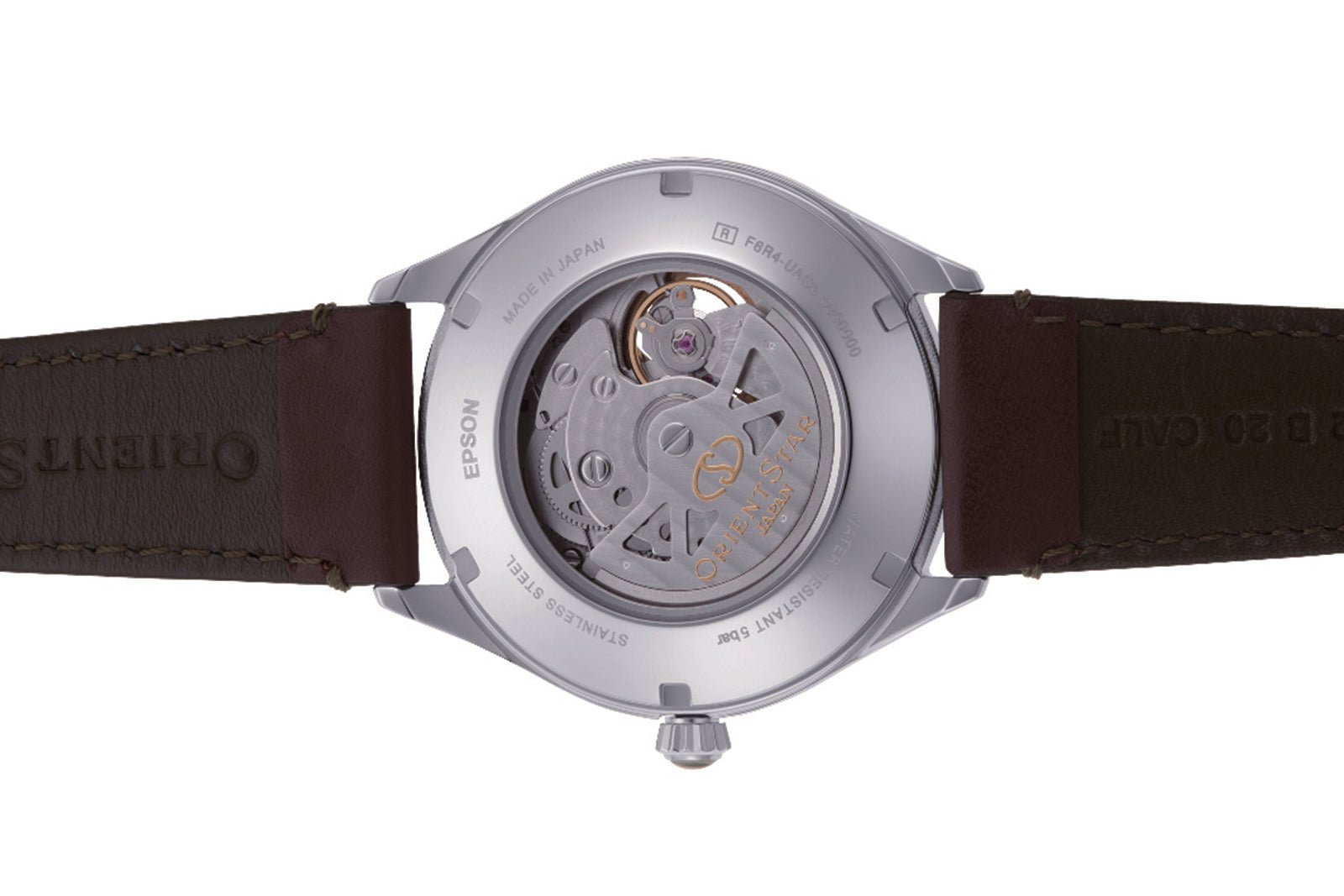
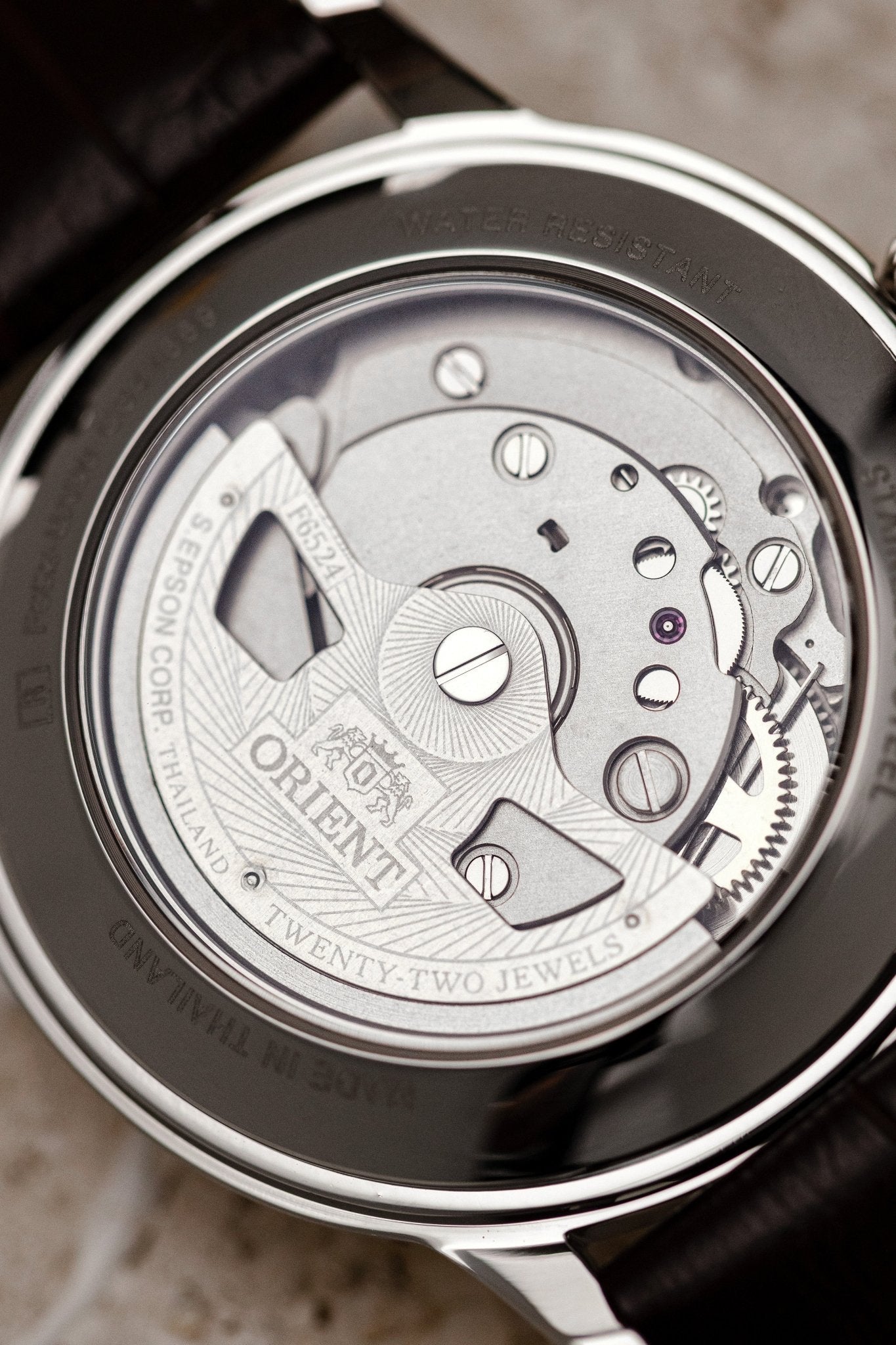
The photo above shows it on an Orient. The Bambino Version 7 RA-BB0102E30B, $305 at Orient Watch USA, has a display back, and its F6524 rotor is engraved ORIENT, S.EPSON CORP. THAILAND and TWENTY-TWO JEWELS. The ring around the glass reads MADE IN THAILAND. We read the tariff schedule’s current edition (Revision 23 of 2026) and the customs regulations that enforce it to see what each of those words is doing there.
What exactly does the rule require?
Note 4 says that any movement or case covered by Chapter 91 “shall not be permitted to be entered unless conspicuously and indelibly marked by cutting, die-sinking, engraving, stamping (including by means of indelible ink), or mold-marking.” A paper label is not on that list. Then it sets out what goes where.
| Part | Where the marking goes | What it must show |
|---|---|---|
| Watch movement | at least one bridge or top plate | maker’s country, maker’s or importer’s name, jewel count spelled out (only jewels that work as bearings) |
| Watch case | the back, inside or out | maker’s country, maker’s or importer’s name |
| Clock movement | front or back plate, where most visible | country, name, jewel count |
| Clock case | outside of the back, where most visible | country only |
Two exceptions follow. Movements “with opto-electronic display only,” meaning digital watches with no hands, are exempt, along with the cases made for them. And the “purchaser” means the US buyer for whose account the goods are imported, so a movement may carry the importer’s name instead of the factory’s.
Why the jewels are written out
Because the rule says “in words.” A movement marked 22 JEWELS would not meet it, and TWENTY-TWO JEWELS does. Jewels matter to the tariff, too. The schedule splits automatic wristwatches into duty lines by jewel count, none or one, two to 17, and more than 17, so the marking tells a customs officer which line applies without opening the watch. The F6524 in our photo, at twenty-two, sits in the top band.
Does the name have to be the maker’s?
It has to be a name, not just a logo. The customs regulation at 19 CFR 11.9(b) allows “either the actual name of the manufacturer or purchaser or a duly registered trade name,” but adds that “a trade-mark shall not be accepted as meeting any such special marking requirement unless it includes the full name.” ORIENT on its own, with the lion crest, is a trademark. S.EPSON CORP. is the company. Orient has been a wholly owned part of Seiko Epson since 2009, as we explain in our piece on Orient’s in-house movements, and the rotor carries both.
What happens if a watch is not marked?
It pays more. Section 11.9(a) says no movement, case or dial covered by the chapter “shall be released for consumption until marked in exact compliance” with Note 4. If an article is found unmarked, “the 10 percent marking duty shall be assessed” unless it is marked, exported or destroyed under customs supervision before the entry is finalized. A separate rule, 19 CFR 134.43(b), describes the watch requirements as “intensive” and says they “require special methods.”
How the ordinary duty on a watch is built
The marking also feeds the duty. Most goods pay a single percentage. Watches pay a compound duty, part per watch and part by component.
| Tariff line | What it covers | Ordinary (general) duty |
|---|---|---|
| 9102.21.10 | Automatic, 0 or 1 jewel, textile or base metal strap | 75 cents each + 6% on the case + 14% on the strap |
| 9102.21.30 | Automatic, 2 to 17 jewels, textile or base metal strap | $1.75 each + 4.8% on the case + 11.2% on the strap |
| 9102.21.70 | Automatic, over 17 jewels, textile or base metal strap | $1.53 each + 4.2% on the case + 9.8% on the strap |
| 9102.21.90 | Automatic, over 17 jewels, other strap (such as leather) | $1.53 each + 4.2% on the case + 2% on the strap |
Here is our worked example, with assumptions we have chosen to keep the arithmetic simple. Take an automatic with 22 jewels on a steel bracelet, so line 9102.21.70, entered at a customs value of $100, of which the importer attributes $40 to the case and $20 to the bracelet. The ordinary duty is $1.53, plus $1.68 on the case, plus $1.96 on the bracelet, a total of $5.17, or about 5.2% of the value. The same watch on a leather strap, line 9102.21.90, would pay $1.53 plus $1.68 plus 40 cents, or $3.61.
That compound structure is why the Section 301 notice now in force for Swiss and Japanese goods spells out a conversion. It sets the sum of the ordinary duty and the Section 301 duty at 12.5% and converts specific or compound duties by dividing the duty owed by the customs value. In our example the ordinary duty works out to 5.17%, so the Section 301 duty would be about 7.33%, and the total $12.50 on $100. We traced how that 12.5% came about in our timeline of US watch tariffs.
Why the country on the caseback matters
Because duty follows origin. The 12.5% rate in that notice applies to products of Switzerland and Japan. The Bambino in our photo is marked as made in Thailand, and its rotor names S.EPSON CORP. alongside THAILAND. We are not going to state the rate for any particular watch, which depends on how customs determines its origin and on rules beyond the scope of this piece. The point is that the marking on the back is the first fact anyone checks.
The words on a rotor are a customs declaration you can read through the glass.
What to look for on your own watch
On a display back, look at the rotor and bridges for the country, the company name and the jewel count in words. On a solid back, the case markings must still show the country and the name. If a watch sold as imported new has none of these, that is worth a question to the seller. And if a reference number on the back is all you can read, our guide to Orient reference numbers explains what it tells you.