A watch made in Switzerland has entered the United States under five different tariff regimes since April 5, 2025. It paid 10%, then 39%, then 15%, then 10% again, and since July 24, 2026 it has paid 12.5%. A watch made in Japan went through four, at 10%, 15%, 10% and 12.5%. Today is one year since the US, Switzerland and Liechtenstein announced the framework that cut the Swiss rate to 15%. That rate lasted about 102 days.
We built the timeline below from the documents that set each rate, which are executive orders, Federal Register notices, a presidential proclamation and the Supreme Court’s opinion of February 20, 2026. Each rate is the extra duty on top of, or blended with, a watch’s ordinary customs duty, which the tariff schedule calls the column 1 or most-favored-nation (MFN) rate.
Every rate since April 2025, with day counts
| From | Swiss watches | Japanese watches | Legal basis | Days in force (our count) |
|---|---|---|---|---|
| Apr 5, 2025 | ordinary duty + 10% | ordinary duty + 10% | Executive Order 14257, IEEPA | 124 days to Aug 6 |
| Aug 7, 2025 | ordinary duty + 39% | 15% in total | EO 14326 (Swiss), EO 14345 (Japan), IEEPA | Swiss 99 days to Nov 13 |
| Nov 14, 2025 | 15% in total | 15% in total | US-Switzerland-Liechtenstein framework notice | about 102 days to Feb 23, 2026 |
| Feb 24, 2026 | ordinary duty + 10% | ordinary duty + 10% | Proclamation 11012, Section 122 | 150 days to Jul 23 |
| Jul 24, 2026 | 12.5% in total | 12.5% in total | Section 301 notice, Trade Representative | 113 days so far |
How did the Swiss rate reach 39%?
Executive Order 14257 of April 2, 2025 set a baseline, under which duties “on all imports from all trading partners shall start at 10 percent,” effective 12:01 a.m. on April 5, 2025. Higher country rates were due on April 9, but Executive Order 14266 suspended them from April 10, and Executive Order 14316 extended the suspension. Executive Order 14326, signed July 31, 2025, replaced the country rates from 12:01 a.m. seven days later. Watches of Switzerland Group, the UK’s largest luxury watch retailer and a large one in the US, described the result in its December 2025 results as “the 39% tariff which has been in place since 7 August 2025.”
Japan reached a deal first. A Commerce notice of September 16, 2025 implemented Executive Order 14345, setting a 15% all-in rate for most Japanese goods. The notice made it apply to goods entered from 12:01 a.m. on August 7, 2025, the same day the Swiss rate rose to 39%.
What did the November 14 framework change?
It put Swiss watches on the Japanese footing. The Federal Register notice published December 18, 2025 applies “the higher of either the U.S. most-favored-nation tariff rate or a tariff rate of 15 percent” to products of Switzerland and Liechtenstein, for goods entered from 12:01 a.m. on November 14, 2025. Because it was published 34 days after it took effect, importers who had paid 39% in the meantime were owed the difference. The notice said refunds “shall be processed pursuant to applicable law and the standard procedures of CBP.”
The notice also carried a condition. The rate was cut “with the understanding and expectation” that a full agreement would be negotiated by the first quarter of 2026, and “if the Agreement is not successfully negotiated by March 31, 2026, the United States will review and reconsider these modifications.” By March 31, the question had been overtaken.
Why did the rate drop to 10% in February?
Because the Supreme Court removed the legal basis for the 39% and 15% rates. In Learning Resources, Inc. v. Trump, decided February 20, 2026, the Court held that the International Emergency Economic Powers Act (IEEPA) “does not authorize the President to impose tariffs.” Every rate in the first three rows of our table rested on IEEPA.
The same day, Executive Order 14389 ordered that the IEEPA duties “shall no longer be in effect and, as soon as practicable, shall no longer be collected.” Proclamation 11012, also signed February 20, used a different law, Section 122 of the Trade Act of 1974, to impose “a temporary import surcharge of 10 percent ad valorem” from February 24. Section 122 limits such a surcharge to 150 days unless Congress extends it, and the proclamation set its end at 12:01 a.m. on July 24, 2026. Unlike the deal rates, it was added on top of the ordinary duty.
The IEEPA duties already paid became refundable, and that is where the refunds in this month’s Japanese results come from. Citizen booked ¥3.9 billion of refunds of tariffs paid under IEEPA, as we reported in our story on Citizen’s watch profit, and Casio counted ¥2.8 billion of refunds in operating profit, ¥1.9 billion of it in watches, covered in our Casio report.
Where does it stand now?
At 12.5% for both countries, under a third law. In March 2026 the Trade Representative opened Section 301 investigations into 60 economies over their failure to ban imports of goods made with forced labor. Its notice of July 28, 2026 imposes duties on products of Switzerland and Japan so that “the sum of the MFN tariff and the Section 301 tariff shall be 12.5 percent,” for goods entered from 12:01 a.m. on July 24, 2026. A product whose ordinary duty is already 12.5% or more pays no Section 301 duty. Where the ordinary duty is a fixed amount rather than a percentage, the notice converts it by dividing the duty owed by the customs value.
What a $1,000 watch has paid at each step
The arithmetic is simplest for a watch with a customs value of $1,000. Customs value is roughly what the importer paid, well below the shop price. Leaving out the small ordinary duty where the extra duty is added on top, our figures run as follows.
- April 5 to August 6, 2025, $100 extra, Swiss or Japanese.
- August 7 to November 13, 2025, $390 extra for a Swiss watch, $150 in total for a Japanese one.
- November 14, 2025 to February 2026, $150 in total for either.
- February 24 to July 23, 2026, $100 extra for either.
- Since July 24, 2026, $125 in total for either.
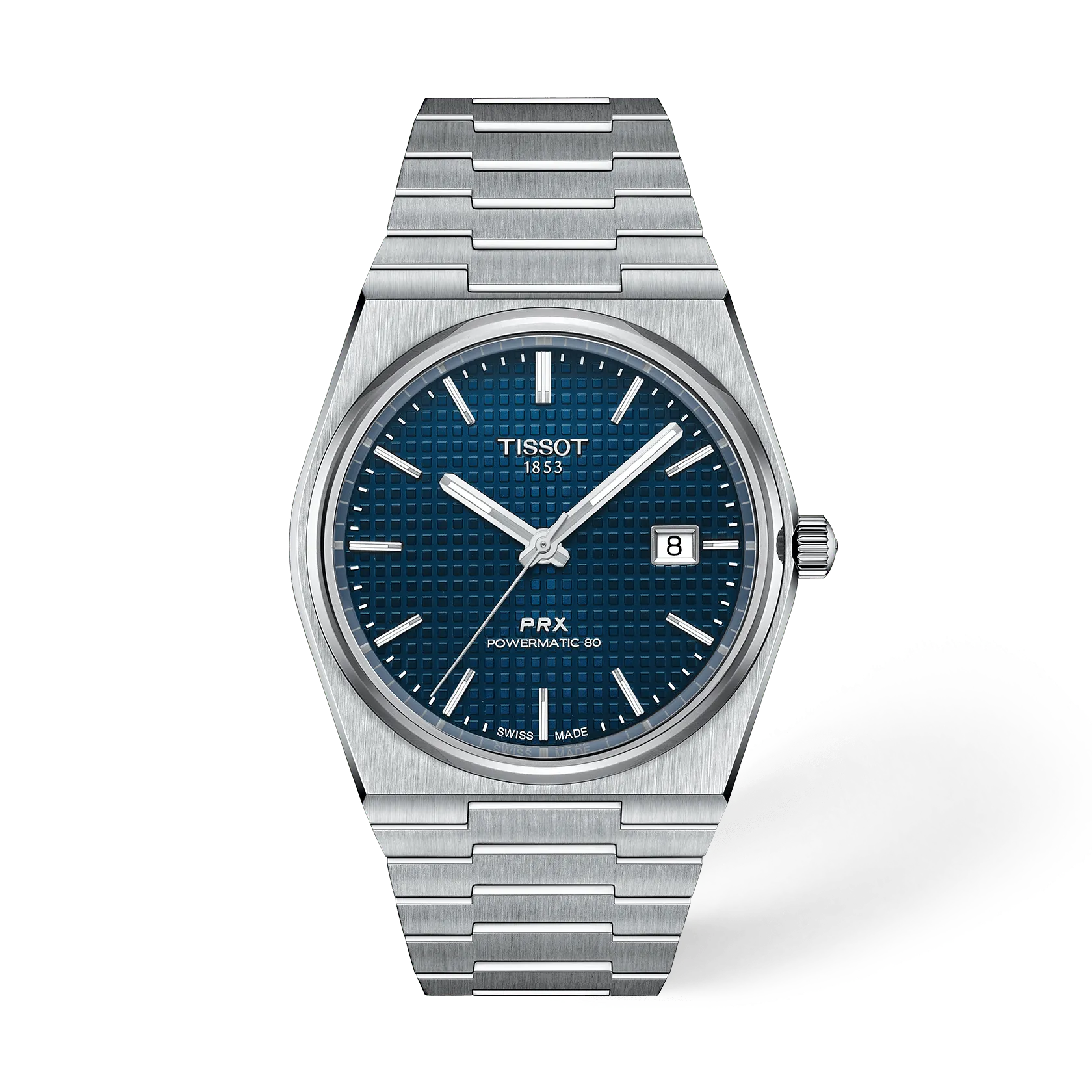
On those numbers the 39% period cost a Swiss importer $240 more per $1,000 of watches than the 15% that followed. The Tissot PRX in the photo, a Swiss-made Powermatic 80, is $850 on Tissot‘s US site.
What happens next
The Section 301 notice gives no end date, unlike the Section 122 surcharge before it. The next dates to watch are company reports rather than government ones. Watches of Switzerland publishes its full first-half results, with the US share of profit, on December 10, 2026, and we cover its November 10 trading update in our report on its US revenue. Swiss watch export figures for October, published by the Federation of the Swiss Watch Industry, will show whether shipments to the US have settled at the new rate.