


Most watches that matter to collectors matter because of something they did first, something they cost or someone who wore them. The Orient Bambino’s case rests on none of those. It is an inexpensive, round, three-hand dress watch on a leather strap. It was not the first watch of its kind, and it is not hard to buy.
It matters anyway, and the reasons say a good deal about how people come into this hobby.
The Entry Point
Every collector has a first mechanical watch. For someone who wants that first watch to be a traditional dress watch, the choice at the bottom of the market is narrower than it looks, because many inexpensive dress watches are quartz.
The Bambino is the obvious exception. It has been on the market since at least 2012, when Worn & Wound reviewed it, and the 38.4mm version is now $295 at Orient Watch USA. For that money a buyer gets an automatic movement, a display back and a design that would not look out of place on a much more expensive watch.
What makes an entry point valuable is not just price. It is whether the watch teaches you anything. A cheap quartz dress watch tells you only the time. The Bambino introduces the things that make mechanical watches what they are. A rotor you can watch turning through the caseback, a power reserve that runs down if you leave it in a drawer, and a seconds hand that steps six times a second rather than once. Some people try it and decide quartz suits them better. Others go on to Orient Star, Grand Seiko or Swiss watches. Either way, they find out.
The Shape
The Bambino’s design is built on two curves. Its crystal is domed, and the dial underneath is convex, curving away toward the edge. The applied baton indices follow the curve, and with the dauphine hands the effect is a watch that looks as though it belongs to the middle of the last century.
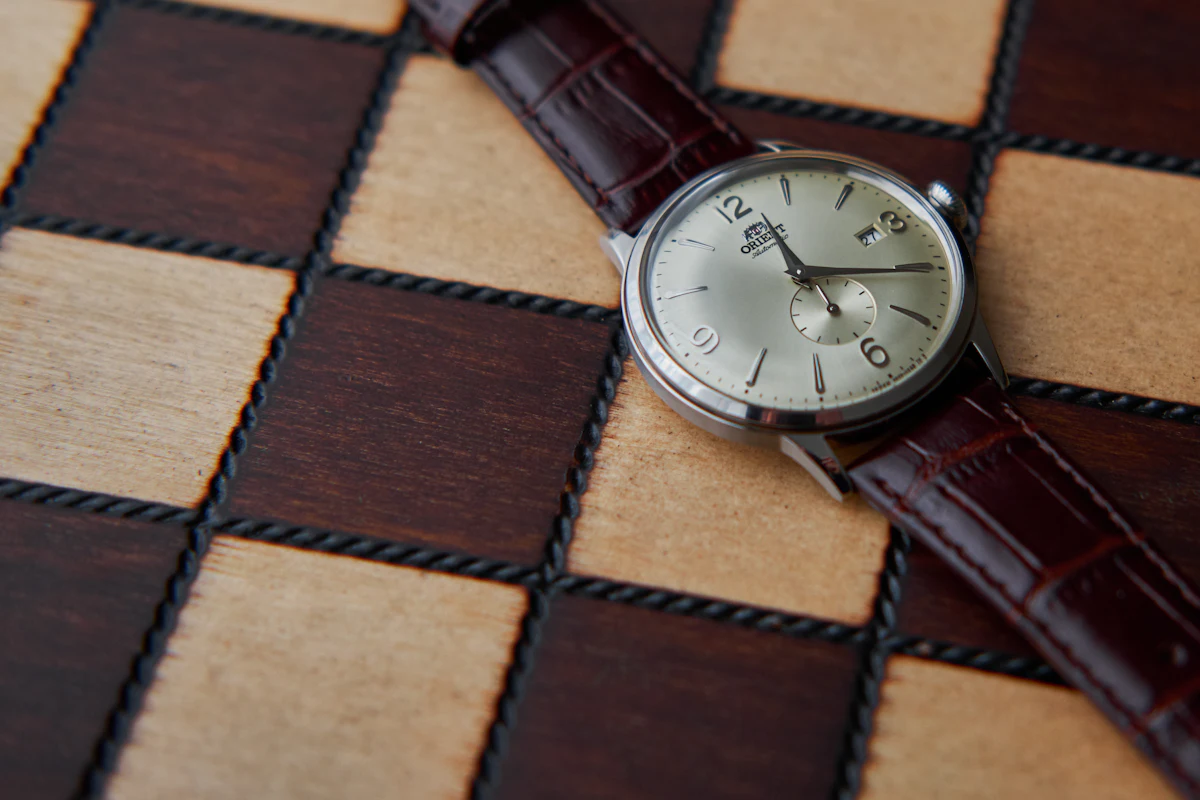
That shape matters because it is the vocabulary of classical watchmaking. A flat dial under a flat crystal is the economical choice. A domed crystal over a convex dial is a deliberate one. The Bambino has given a lot of people their first look at how a dial and crystal can work together to give a watch depth.
It is also a quiet design. There is no logo theater, no oversized date and no borrowed motif from a famous Swiss reference. The case is polished and brushed, the bezel is plain, and the crown is a simple push/pull type. A first-time buyer learns, without being told, that a dress watch can be plain and still look considered.
The Quiet Fix
For its first few years, the Bambino had a flaw that was easy to spot on the spec sheet. Its original caliber, Orient’s 48743, did not hack, so the seconds hand kept running while you set the time. It also could not be wound by hand. If the watch stopped, you had to swing or wear it to get it going again.
Around 2016 Orient moved the Bambino to the F6724. The new caliber keeps the 21,600 vibrations per hour and about 40 hours of power reserve, but adds hacking and hand-winding. The jewel count went from 21 to 22. Orient rates it at +25/−15 seconds per day.
The Bambino’s most important upgrade happened inside the case.
The name stayed the same, and the formula stayed the same. The watch simply became complete. That kind of improvement is easy to overlook, and it says something about the Bambino’s place in the culture. It was already the default recommendation. The fix meant the recommendation no longer came with a caveat about the movement. We cover the details in our full Bambino review.
In 2026 Orient took another step in the same direction, adding a Bambino No Date with the F6524 caliber. For buyers who would rather not have a window at 3, it removes the one element that interrupted the dial.
The Size
For years, many mainstream watches got larger, dress watches included. The Bambino is still offered at 40.5mm, and that size has its buyers.
The 38.4mm Bambino matches where taste has moved since. At 38.4mm across with a 44mm lug-to-lug, it is closer to classical dress watch proportions than the larger case. Seiko‘s new Presage Cocktail Time came in at 38.5mm in July 2026, alongside the older 40.5mm version. We look at the broader shift in the quiet return of the 38mm watch.
A smaller Bambino matters because size is one of the first things a new collector learns to judge. A 38mm watch at $295 lets someone discover that a smaller case can feel more correct, without having to buy an expensive watch to find out.
What the Price Says
The most interesting thing about the Bambino is not on the dial. It is how a hacking, hand-winding automatic made by the brand’s own group reaches a buyer at $295.
Orient is part of Seiko Epson. It has been a wholly owned Epson subsidiary since 2009 and was fully integrated into the company in 2017. Its movements are made by Akita Epson Corp. in Yuzawa, in Akita Prefecture. Orient does not buy calibers from a supplier and add its margin. It sells movements made within its own group.
That is the economic story behind the Bambino. Tissot‘s dress watch at a similar price, the Everytime, is quartz. The Bambino can offer an in-house automatic because Orient sits within an electronics company that makes movements at scale. We look at Orient’s wider value case in why Orient keeps showing up in the value conversation.
The price also explains the compromises. The crystal is mineral rather than sapphire, water resistance is 30m and there is no lume. The display back, according to Monochrome’s review, is a snap-in type. Those are the costs a buyer accepts in exchange for the movement and the shape.
Why It Still Matters
None of this makes the Bambino a great watch in the way a Grand Seiko is a great watch. It is not finished to that standard, and it does not try to be. Seiko’s Presage, at $475, does more with its dial and case.
What the Bambino does is keep the door open. It shows a new buyer what a domed crystal, a convex dial and a hacking automatic are, and it does so for less than $300. A hobby that can feel like it begins at several thousand dollars needs watches like that. For more than a decade, the Bambino has been one of the clearest examples, and the current version is the best it has been.


