


| OrientMako (Mako-3) | CitizenPromaster Dive Automatic | |
|---|---|---|
| Price (US) | $375 (edge) | $625 |
| Reference | RA-AA0820R39B | NY0136-52L |
| Movement | Orient F6922, automatic | Citizen 8204, automatic |
| Power reserve | About 40 hours | About 42 hours (edge) |
| Rated accuracy | +25/−15 sec/day (edge) | +40/−20 sec/day |
| Hacking / hand-winding | Yes / Yes | Yes / Yes |
| Jewels | 22 | 21 |
| Beat rate | 21,600 vph | 21,600 vph |
| Case diameter | 41.8mm (edge) | 44mm |
| Thickness | 12.8mm | Not published |
| Lug to lug | 46.8mm | Not published |
| Lug width | 22mm | 20mm |
| Crystal | Sapphire | Sapphire |
| Caseback | Not published | Solid, engraved |
| Water resistance | 200m | 200m, ISO compliant (edge) |
| Bezel | Unidirectional, 120 clicks, color-matched insert | Unidirectional, serrated, aluminum insert |
| Crown | Screw-down | Screw-down, at 8 o’clock |
| Lume | Luminous hands and markers | Luminous hands and markers |
| Bracelet / strap | Steel bracelet, fold-over clasp with safety | Steel bracelet, fold-over clasp with push buttons |
| Warranty | 3 years (Orient Watch USA) | 5 years (Citizen USA) (edge) |
Price
The Mako-3, reference RA-AA0820R39B, is $375 at Orient Watch USA.
Citizen USA lists the Promaster Dive Automatic NY0136-52L at $625. That is $250 more than the Mako, or two thirds again on top of the Orient’s price.
The rest of this comparison is about what that $250 buys.
Design
The Mako line goes back more than two decades. The first one arrived in 2004 as the EM65, powered by caliber 46943. The Mako II followed in April 2016 and was among the first Orients to use the F6922 caliber. Orient Watch USA dates the current Mako-3 generation to 2023.
Today’s Mako shares its case, bezel construction, sapphire crystal and movement with the Kamasu. It differs in the dial, the hands and a bezel insert matched to the dial color. The reference here has a bordeaux dial.
The Citizen takes its look from the pufferfish. Citizen calls the serrated bezel a “Fugu” design, after the Japanese name for the fish, and the blue aluminum insert carries the same color as the dial. The crown sits at 8 o’clock, on the left side of the case, and the solid caseback is engraved with a pufferfish.
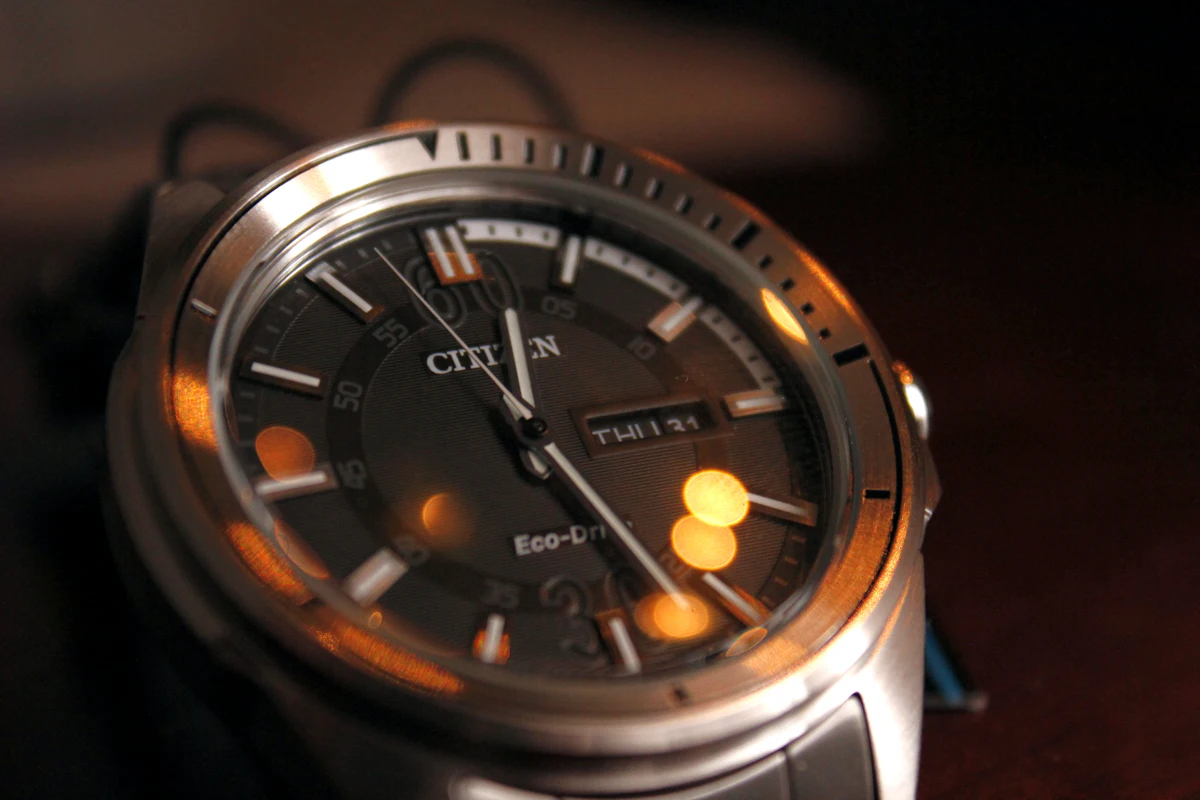
The Citizen is the more distinctive of the two. The left-hand crown and the serrated bezel make it recognizable across a room. The Mako is a more conventional dive watch, which will suit some buyers better.
Movement
The Mako uses Orient’s F6922, made in Akita Prefecture by Akita Epson. It has 22 jewels, beats at 21,600 vph, runs for about 40 hours, hacks, hand-winds and shows the day and date.
The Citizen uses the 8204, a Miyota caliber from Citizen’s own 82 family. It has 21 jewels, the same 21,600 beat rate and about 42 hours of reserve, and it also hacks, hand-winds and shows the day and date. Citizen’s Tsuyosa uses a close relative, the 8210, which we cover in our Citizen Tsuyosa review.
These are very similar movements. The Citizen has the slightly longer reserve, and the Orient has the tighter accuracy rating. Of the two, the rating is the more useful difference, since a gap of two hours rarely decides whether a watch is still running on Monday morning. Our explainer on Orient’s in-house movements covers the F6922 in more depth.
Case and Dimensions
The Mako measures 41.8mm across, 12.8mm thick and 46.8mm lug to lug, with 22mm lugs and a screw-down crown.
The Citizen measures 44mm across, with 20mm lugs and a screw-down crown at 8. Citizen does not publish its thickness or lug-to-lug length, and we have not been able to confirm either from a reliable source, so both are left out of the table.
The missing figures make a direct comparison harder, but the diameter alone puts the Citizen 2.2mm wider.
Citizen did once offer a smaller option. The older 41mm NY0120 and NY0125 were the obvious choice for buyers who found 44mm too large. They are no longer on Citizen’s US site, and neither is the NY0040, which used the earlier 8203 caliber without hacking. A US buyer shopping Citizen’s own store today gets the 44mm NY0136, and that is the watch compared here.
Dial
The Mako-3’s bordeaux dial has a grained finish, with Arabic numerals at 6, 9 and 12 and luminous hands and hour markers. The day and date sit at 3.
The Citizen’s blue dial uses large luminous markers and luminous hands, with the day and date at 3.
The Orient’s grained finish and partial numerals give it a more decorative face. The Citizen’s large markers put legibility first, which is the more traditional priority for a diver. Neither approach is wrong, and this round is a matter of taste.
Crystal
Both watches use sapphire. Citizen highlights its scratch resistance and hardness, and the same holds for the Mako’s crystal. This row is a tie, and it is a good sign for both that neither maker cut a corner here.
Accuracy
Orient rates the F6922 at +25/−15 seconds a day. Citizen rates the 8204 at +40/−20. The Orient’s window is 40 seconds wide, and the Citizen’s is 60, with a larger allowance for running fast.
A rating sets the limits a maker will accept, not a promise about any one watch. Still, it is the only published basis for comparison, and the Orient’s is clearly tighter. Our guide to reading a watch spec sheet explains why these figures deserve attention.
Water Resistance
Both are rated to 200m and both have screw-down crowns, so on the headline figure they are equal.
The difference is certification. Citizen describes the Promaster as “ISO compliant,” a reference to ISO 6425, the international standard for divers’ watches. Among other things, the standard calls for every watch to be tested and for the watch to be legible in the dark. Orient makes no ISO claim for the Mako, and its product page does not mention the standard.
That gives the Citizen a clear win in this row. For most owners the practical gap is small, since both watches carry the same depth rating. But a maker’s compliance claim is a meaningful commitment, and buyers who want a dive watch that meets a published standard should take it seriously. Within Orient’s range, the ISO 6425 rated option is the Orient Star Sports Diver RE-AU0301B00B, listed at $700 but out of stock at Orient Watch USA at the time of writing.
On the Wrist
This is where the comparison turns. On the published dimensions, the Mako is a 41.8mm watch with a 46.8mm lug-to-lug and a 12.8mm case, figures that suit a wide range of wrists.
The Citizen’s 44mm diameter is large by current standards, and without published thickness or lug-to-lug figures it is hard to judge how compact the case is in practice. Its 20mm lugs are narrow for a case that wide, which on paper makes the head look larger relative to the bracelet.
The Citizen does have one advantage. With the crown at 8 o’clock, it sits on the left side of the case, where it cannot press into the back of a wearer’s hand when the wrist bends. That is the usual argument for the layout.
For a watch meant to be worn every day, under cuffs and at a desk as well as in the water, the Mako’s dimensions are the easier ones to live with.
Quality
The Citizen has the stronger build specifications on paper. Its steel bracelet closes with a fold-over clasp released by push buttons, the caseback carries an engraving and the whole package is backed by an ISO compliance claim.
The Mako’s steel bracelet uses a fold-over clasp with a safety catch. The Kamasu, which shares its case, uses a stamped clasp, and reviewers report hollow end links on its bracelet, which Orient does not confirm. Buyers should expect the Mako’s bracelet to be built to the same $375 price.
Neither maker publishes much about case finishing. On the evidence available, the Citizen’s build is the more convincing, and it takes Best Build on that basis.
Long-Term Ownership
Citizen gives the NY0136 a 5-year limited warranty. Orient Watch USA’s warranty is 3 years. Two extra years of cover is a real advantage, and it goes some way toward explaining the Citizen’s higher price.
Both movements should be straightforward to service. Miyota calibers are found in watches across the industry, and the F6922 has been in Orient’s catalog since 2016, so neither is an obscure caliber.
Both watches have sapphire crystals and screw-down crowns, so neither should age badly through ordinary wear.
Value
At $375, the Mako delivers a sapphire crystal, a 200m rating, a screw-down crown, a hacking and hand-winding automatic and the tighter accuracy rating, in a case 2.2mm narrower than the Citizen’s.
The Citizen asks $250 more. In return it adds an ISO compliance claim, two more years of warranty, two more hours of reserve and the distinctive crown and bezel design. Those are worthwhile, but they are refinements rather than a different class of watch.
The Citizen is the more credentialed diver. The Mako is the easier watch to wear every day, and it costs $250 less.
Buyers who prefer the Mako’s specification but not its dial have an easy alternative. The Kamasu uses the same case, crystal and movement at the same $375, and our Kamasu review covers it in full. For a Seiko comparison at a similar price, see the Kamasu against the Seiko 5 Sports.
Verdict
- Best Value
- Orient Mako (Mako-3)
- Best Movement
- Orient Mako (Mako-3)
- Best Build
- Citizen Promaster Dive Automatic
- Editor’s Pick
- Orient Mako (Mako-3)
As an everyday dive watch, the Mako is the better choice. It is the smaller watch, it carries the tighter accuracy rating and it costs $250 less, while matching the Citizen on depth rating, crystal and crown. Its Best Movement award is narrow and rests on that rating. The Citizen runs about two hours longer.
The Citizen earns Best Build for its ISO compliance claim and push-button clasp, and its 5-year warranty is the best in this comparison. Buyers who will actually dive, who want a maker’s commitment to a published standard, or who simply like a large watch with a left-hand crown should choose the Promaster and will not regret the extra money. Everyone else will find the Mako does almost everything the Citizen does, in a size that suits more wrists.


