


| OrientTX02 Solar Chronograph | CitizenEco-Drive Endeavor Chrono | |
|---|---|---|
| Price (US) | $350 (edge) | $650 |
| Reference | RA-TX0203S10B | CA4730-59A |
| Movement | Orient VS752, solar quartz chronograph | Citizen B620, eco-drive (light-powered quartz) |
| Power reserve | About 6 months when fully charged | At least 6 months (caliber B620, per Worn & Wound) |
| Rated accuracy | ±20 sec/month | ±15 sec/month (caliber B620, per Worn & Wound) (edge) |
| Case diameter | 42.8mm | 44mm |
| Thickness | 13.1mm | Not published |
| Lug to lug | 48.1mm | Not published |
| Lug width | 22mm | 22mm |
| Crystal | Flat sapphire | Sapphire |
| Caseback | Screw-down | Not published |
| Water resistance | 200m (edge) | 100m |
| Bezel | Unidirectional, 120 clicks, stainless steel bezel | Scalloped-edge rotating 60-minute bezel with ceramic insert |
| Crown | Screw-down | Not published |
| Lume | Luminous hands and hour markers | Luminous hands |
| Bracelet / strap | 316L stainless steel bracelet, fold-over clasp with safety | Stainless steel bracelet, fold-over clasp with push buttons |
| Warranty | 3 years (Orient Watch USA) | 5 years (Citizen USA limited warranty) (edge) |
Price
The TX02 Solar Chronograph, reference RA-TX0203S10B, is $350 at Orient Watch USA.
Citizen USA sells the Endeavor Chrono CA4730-59A for $650.
The Citizen costs $300 more than the Orient, close to double, so it has to justify a real premium.
Design
The TX02 is a chronograph built on a dive-watch template. Orient’s global site files it under “Diver Design Chronograph solar-powered” and dates it to April 2023. It has a 120-click unidirectional bezel, a screw-down crown and a white dial that the Orient Watch USA page title describes as a panda layout. Neither Orient site calls it a diver’s watch or claims ISO 6425.
The Endeavor takes a different line. Its rotating 60-minute bezel has a scalloped edge and a ceramic insert, and its white dial is wave-textured, with contrasting chronograph registers and a blue chronograph seconds hand. Citizen does not say which way the bezel turns, and it does not call the Endeavor a Promaster, though it shares a caliber with one, as the next section explains.
On published detail, the Citizen has the more distinctive dial. The Orient has the more purposeful case.
Movement
Both watches are light-powered quartz chronographs, so the usual mechanical measures do not apply. There are no jewels or beat rates to compare, nothing to hack and nothing to wind. Light charges each watch, and the useful questions become how long a full charge lasts, how accurate the movement is and what the chronograph can do.
The TX02 uses Orient’s caliber VS752, which Orient’s global site lists as a light-charge movement. It runs for about six months on a full charge. Orient’s specifications cover hours, minutes, a chronograph and a date, and stop there. Orient does not publish the chronograph’s measuring range, the layout of its subdials or whether the watch has a running seconds hand. For a watch sold as a chronograph, that is an unusual omission.
The Endeavor uses Citizen’s Eco-Drive caliber B620. Citizen states that its chronograph measures up to 60 minutes in 1/5-second steps, that the watch shows 12/24-hour time and that the date sits between 4 and 5 o’clock. Citizen’s product page gives no power reserve or accuracy figure. **The figures we use come from Worn & Wound’s hands-on with the Citizen Promaster Navihawk 40, which uses the same B620 caliber**, and they are at least six months on a full charge and ±15 seconds a month. We were not able to check them against Citizen’s own documentation.
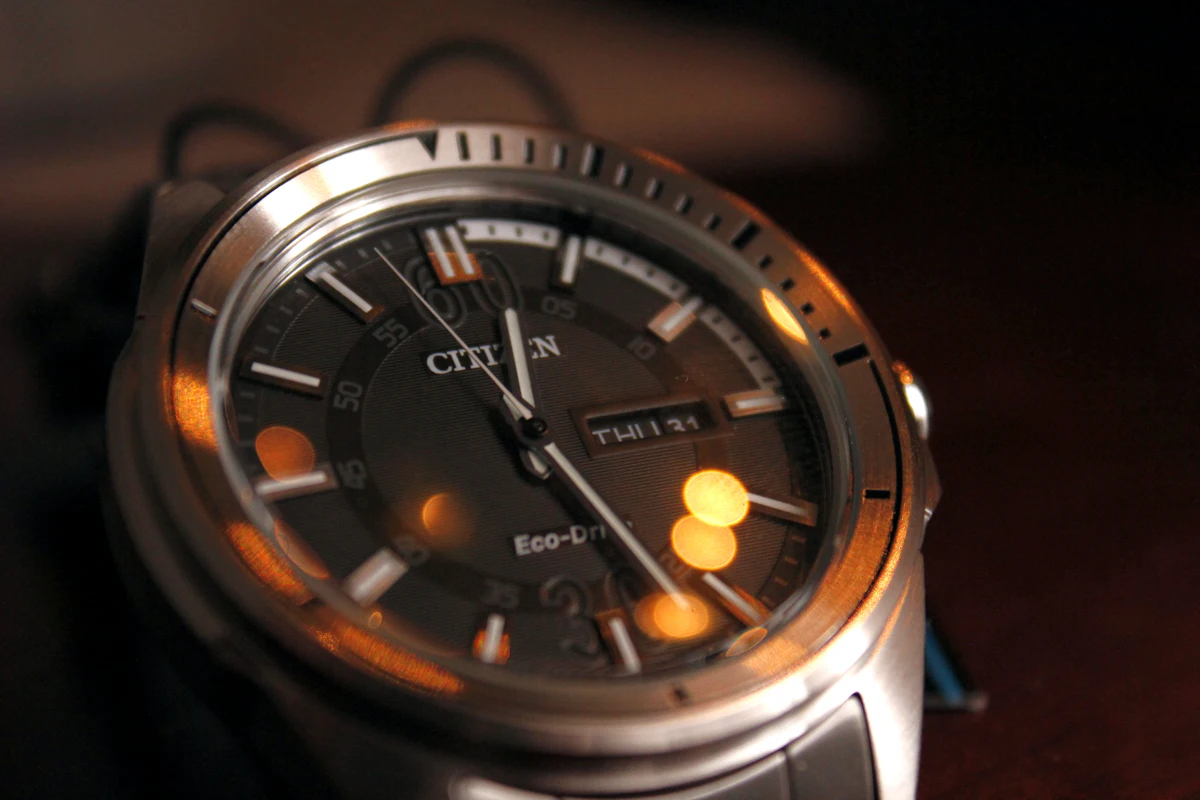
The reserves are effectively equal. The Citizen takes Best Movement because its chronograph is far better described and its reported accuracy is tighter. A buyer knows the Endeavor times up to 60 minutes in fifths of a second. With the TX02, even that much has to be worked out from photographs.
Case and Dimensions
The TX02 measures 42.8mm across, 13.1mm thick and 48.1mm from lug to lug, with 22mm lugs. Its caseback and crown both screw down, and Orient’s global site gives its weight on the bracelet as 167g.
The Endeavor measures 44mm across, with 22mm lugs. Citizen does not publish its thickness, lug-to-lug length, caseback type or crown type, and we have not confirmed them from a reliable source, so they appear as not published in the table.
The diameter alone makes the Citizen 1.2mm wider. Without the other figures, that is as far as a direct comparison can go.
Dial
Orient describes the TX02’s dial as white and gives it luminous hands and hour markers. Its page title calls the layout a panda, the collector’s term for a light dial with dark registers, but Orient does not say how many registers there are or what each one records.
The Endeavor’s white dial has a wave texture, contrasting registers and a blue chronograph seconds hand. Citizen mentions luminous hands but does not say whether the markers are luminous, and it does not specify the number or position of the registers either.
The Citizen’s dial is the more elaborate and the better described. The Orient’s lume on both hands and markers is the more complete specification for reading the time in the dark.
Crystal
Both watches use sapphire. Orient specifies a flat sapphire for the TX02, and Citizen describes the Endeavor’s crystal simply as sapphire. Both should resist scratches far better than mineral glass. This row is a tie.
Accuracy
Orient rates the VS752 at ±20 seconds a month. Worn & Wound reports ±15 seconds a month for the B620. If that figure holds, the Citizen is the more accurate movement by five seconds a month.
The practical gap is small. Both figures work out to less than a second a day, and both are far tighter than any mechanical watch in this price range. For comparison, Orient rates its F6 automatics at +25/−15 seconds a day. The Citizen takes this row, with the caveat that its figure comes from a reviewer rather than from Citizen.
Water Resistance
The TX02 is rated to 200m, with a screw-down crown and a screw-down caseback. The Endeavor is rated to 100m, and Citizen does not publish the type of crown or caseback.
That gives the Orient a clear advantage. It is not a certified diver’s watch, and Orient makes no ISO 6425 claim for it. But for swimming, snorkeling or a watch that simply never needs to come off, it has double the rating and the more reassuring published specification.
On the Wrist
The TX02 is not a small watch. At 42.8mm, 13.1mm thick and 48.1mm long, with 167g on its bracelet, it will wear with presence on most wrists. Buyers with slimmer wrists should look closely at that 48.1mm length.
The Endeavor is wider still at 44mm. Without a published thickness or length, it is hard to say how it compares in practice, but on diameter it is the larger watch.
Both have 22mm lugs, so both take standard straps easily. For buyers who want the smaller of the two, the Orient is the safer choice on the available figures.
Quality
The Orient has the more robust documented specification. Its 316L steel bracelet closes with a trifold deployant buckle that Orient’s global site says has a push button and a security latch. The crystal is flat sapphire, and the crown and caseback both screw down.
The Citizen has one clear advantage in materials. Its bezel insert is ceramic, a material that generally resists scratches and fading better than aluminum. Orient does not state the material of the TX02’s bezel insert. The Endeavor’s steel bracelet closes with a fold-over clasp released by push buttons.
The rest of the Citizen’s build is hard to judge, because Citizen publishes so little about the case. A missing specification is not a weaker one, and the only premium material either maker names is the Citizen’s ceramic insert, so neither watch takes a Best Build award. The Orient takes Best for Water instead, on its 200m rating and its screw-down crown and caseback.
Long-Term Ownership
Citizen covers the Endeavor with a 5-year limited warranty in the US. Orient Watch USA’s warranty is 3 years. Two extra years is a meaningful advantage on a watch meant to run for a long time without attention.
Neither needs the routine battery changes of a conventional quartz watch, since light keeps both charged. Both have sapphire crystals and steel bracelets. The Orient’s screw-down crown and caseback are the more conservative choices for a watch that will be worn in water.
Value
At $350, the TX02 offers a solar chronograph movement, a flat sapphire crystal, 200m, a screw-down crown and caseback and a 120-click bezel. Its weakness is documentation, since Orient does not say what its chronograph measures.
At $650, the Endeavor adds a documented 60-minute chronograph with 1/5-second resolution, 12/24-hour time, a ceramic bezel insert, a slightly tighter reported accuracy figure and two more years of warranty. It gives up half the depth rating and costs $300 more.
The Citizen is the better described chronograph. The Orient is the more capable watch, and it costs $300 less.
At $650, the Citizen is hard to justify against the Orient.
Verdict
- Best Value
- Orient TX02 Solar Chronograph
- Best Movement
- Citizen Eco-Drive Endeavor Chrono
- Best for Water
- Orient TX02 Solar Chronograph
- Editor’s Pick
- Orient TX02 Solar Chronograph
For most buyers, the TX02 is the better choice. It costs $350, is rated to twice the depth, has a screw-down crown and caseback and is 1.2mm narrower. It takes Best Value, Best for Water and our pick.
The Endeavor earns Best Movement, and it is the right watch for anyone who will actually use the chronograph and wants to know exactly what it can time. Its ceramic bezel insert and five-year warranty are real advantages. For everyone else, the Orient offers more watch for much less money.


