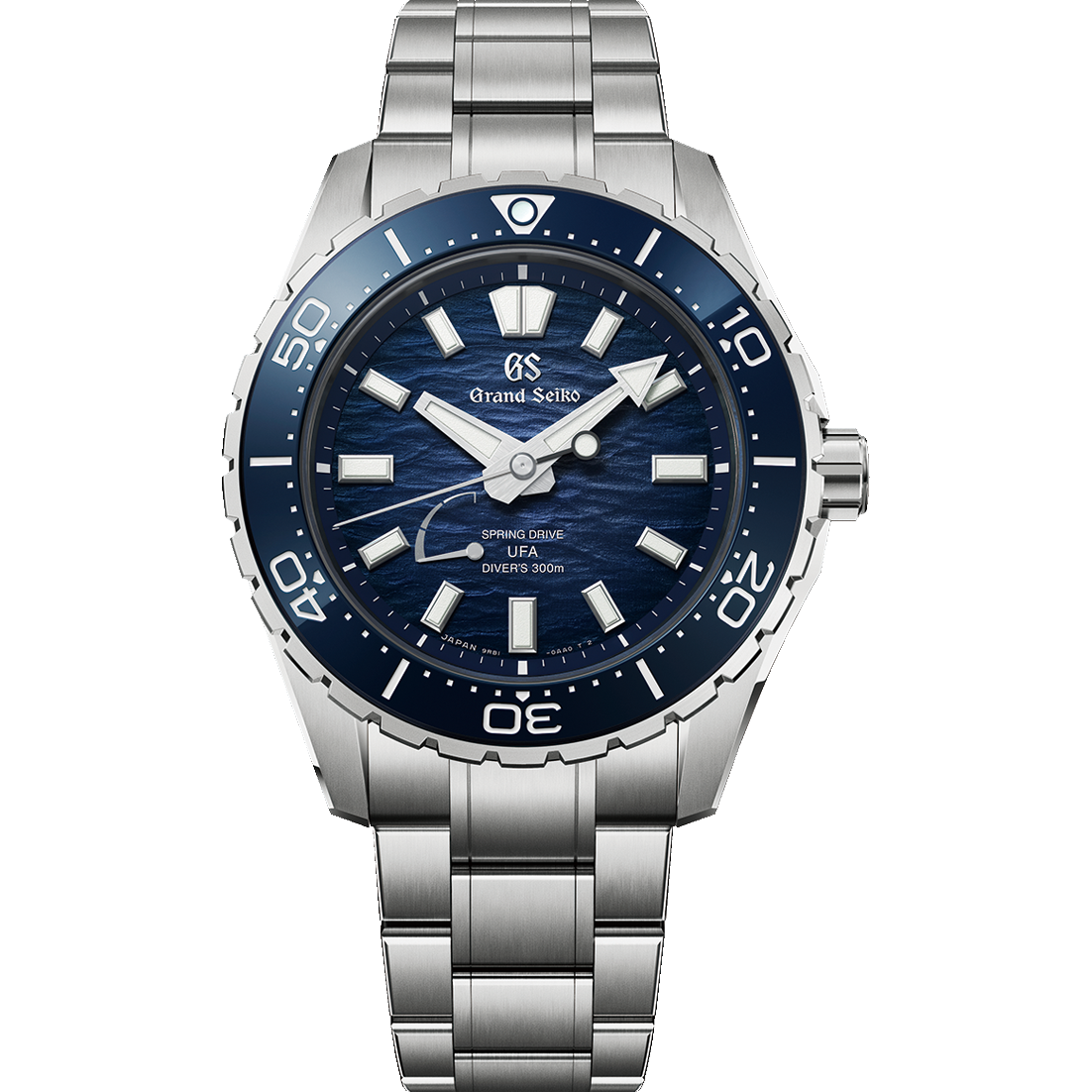
Grand Seiko rates the movement in its SLGB023 diver at ±20 seconds a year, and on its own US product page it gives a second figure beside it, ±3 seconds a month. Those two numbers do not divide into each other, and the gap between them is the most useful thing to understand about the watch that won the Sports Watch Prize at the Grand Prix d’Horlogerie de Genève on November 7.
The SLGB023, sold as the Evolution 9 Spring Drive U.F.A. Ushio 300 Diver, is $12,400 from Grand Seiko in the US. It was one of only three GPHG winners this year priced under CHF 20,000, as our table of every 2026 winner by price shows.
What is U.F.A., and how is it different from other Spring Drive?
U.F.A. stands for Ultra Fine Accuracy. It is Grand Seiko’s name for a tighter-regulated generation of Spring Drive, the hybrid movement that is powered by a mainspring like a mechanical watch but governed by a quartz crystal and an electronic circuit. Our Spring Drive explainer covers how that regulation works.
The first U.F.A. caliber, the 9RB2, was unveiled in 2025, per Grand Seiko’s GPHG entry. On Grand Seiko’s US site today it powers the 37mm SLGB003. The SLGB023 uses the 9RB1, which Grand Seiko’s GPHG entry describes as “specially adapted for enhanced robustness to meet the demands of diving while maintaining the exceptional annual accuracy of ±20 seconds.” The same entry calls the 9RB2 “the most accurate mainspring-powered wristwatch movement in history,” with a footnote that the claim is as of June 2026 and “based on Grand Seiko’s research.”
How does ±20 seconds a year compare with Grand Seiko’s other calibers?
We took the accuracy rating from the US product page of one current watch for each of seven Grand Seiko calibers and worked out the worst case each rating allows over a day, a 30-day month and a 365-day year. Where Grand Seiko states a figure directly, we use its figure. Where it does not, the number is our arithmetic and is marked with an asterisk.
| Caliber (watch checked) | Type | Grand Seiko’s rating | Per day | Per month | Per year |
|---|---|---|---|---|---|
| 9RB1 (SLGB023) | Spring Drive U.F.A. | ±20 s/year, ±3 s/month | ±0.05 s* | ±3 s | ±20 s |
| 9RB2 (SLGB003) | Spring Drive U.F.A. | ±20 s/year, ±3 s/month | ±0.05 s* | ±3 s | ±20 s |
| 9F62 (SBGX261) | Quartz | ±10 s/year | ±0.03 s* | ±0.8 s* | ±10 s |
| 9RA5 (SLGA001) | Spring Drive | ±10 s/month, ±0.5 s/day | ±0.5 s | ±10 s | ±120 s* |
| 9R65 (SBGA211) | Spring Drive | ±15 s/month, ±1 s/day | ±1 s | ±15 s | ±180 s* |
| 9R66 (SBGE295) | Spring Drive | ±15 s/month, ±1 s/day | ±1 s | ±15 s | ±180 s* |
| 9SA5 (SLGH019) | Mechanical | +5 to −3 s/day mean, +8 to −1 s/day in normal use | +8 to −1 s | +240 to −30 s* | +2,920 to −365 s* |
| 9S85 (SBGH351) | Mechanical | +5 to −3 s/day mean, +8 to −1 s/day in normal use | +8 to −1 s | +240 to −30 s* | +2,920 to −365 s* |
Compiled from grand-seiko.com/us-en product pages, opened November 10, 2026. Per-day figures for the year ratings are rounded. Mechanical yearly and monthly figures use the “normal usage” rating. Our compilation and arithmetic.
Two things stand out. The first is that U.F.A. is still not as tight as Grand Seiko’s own quartz. The 9F62 in the $2,700 SBGX261 is rated at ±10 seconds a year, half the U.F.A. tolerance. The second is the size of the step from older Spring Drive. A 9R65 is allowed up to three minutes a year, nine times the U.F.A. figure.
The monthly limit is looser than the yearly one divided by twelve. That is the honest part of the rating.
Why ±3 seconds a month, and not ±1.7?
If the 9RB1 drifted by the same amount every month, ±20 seconds a year would mean about ±1.7 seconds a month. Grand Seiko instead allows ±3 seconds in any single month. Its page does not explain the difference, so we will not invent a reason. What the two figures together say is that a given month can run further off than the yearly average implies, as long as the year comes back inside ±20 seconds. Anyone who checks the watch against a time signal after a single month should hold it to ±3 seconds, not to a twelfth of the annual figure.
The mechanical calibers carry a different kind of fine print. Grand Seiko’s “mean daily rate” of +5 to −3 seconds is measured on the movement before it is cased, in six positions over 12 days in a controlled environment, per the wording on the product page. The figure it gives for “normal usage” is wider, at +8 to −1 seconds a day. Our earlier piece on how accuracy ratings translate into monthly drift covers the same distinction for affordable calibers.
The rest of the SLGB023’s spec sheet
Per Grand Seiko’s US page, the SLGB023 has a 40.8mm case, 12.9mm thick and 48.5mm from lug tip to lug tip, with 21mm lugs. Case and bracelet are in what Grand Seiko calls High-Intensity Titanium, and the whole watch weighs 122g. It is rated as a 300m diver’s watch, has a sapphire crystal with anti-reflective coating on the inner surface, resists magnetism to 4,800 A/m and runs about 72 hours on a full wind, with a power reserve indicator on the dial.
Grand Seiko’s GPHG entry calls it “Grand Seiko’s smallest diver’s watch ever.” The blue Ushio dial, from the Japanese word for tide, has appeared on the brand’s divers since 2022, per the same entry.
For scale within the U.F.A. family, the 37mm SLGB003 dress watch with the 9RB2 is $11,400 and weighs 100g. The diver adds 3.8mm of width, 1.5mm of thickness, a rotating bezel and 300m of water resistance for $1,000 more.
What to watch for
Grand Seiko’s US site now lists U.F.A. in a 37mm dress watch and a 40.8mm diver. The GPHG rules keep prize-winning watches on the foundation’s exhibition circuit until December 11, 2026. The next question is whether a third U.F.A. caliber appears, and in what case, when Grand Seiko shows its 2027 collection.