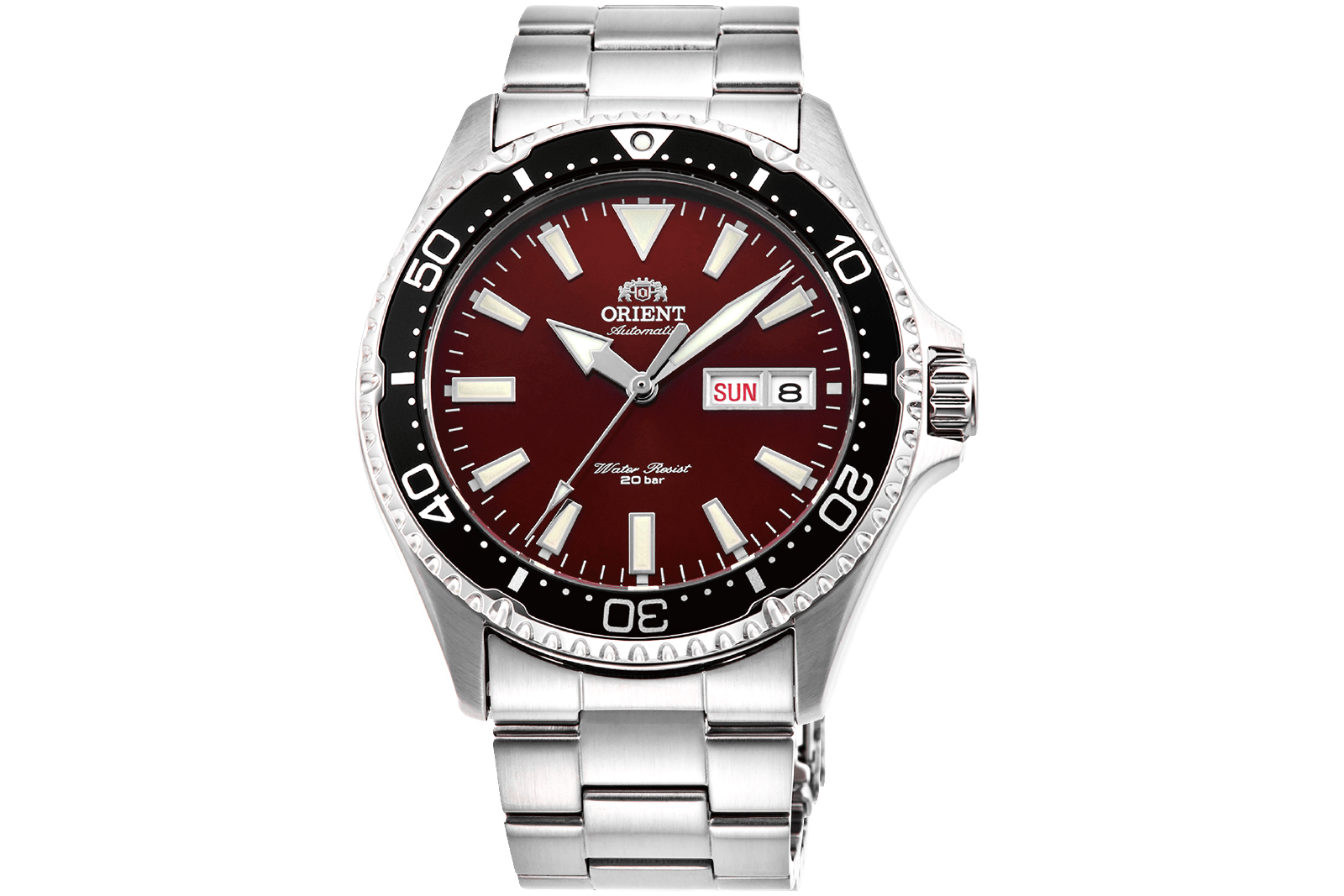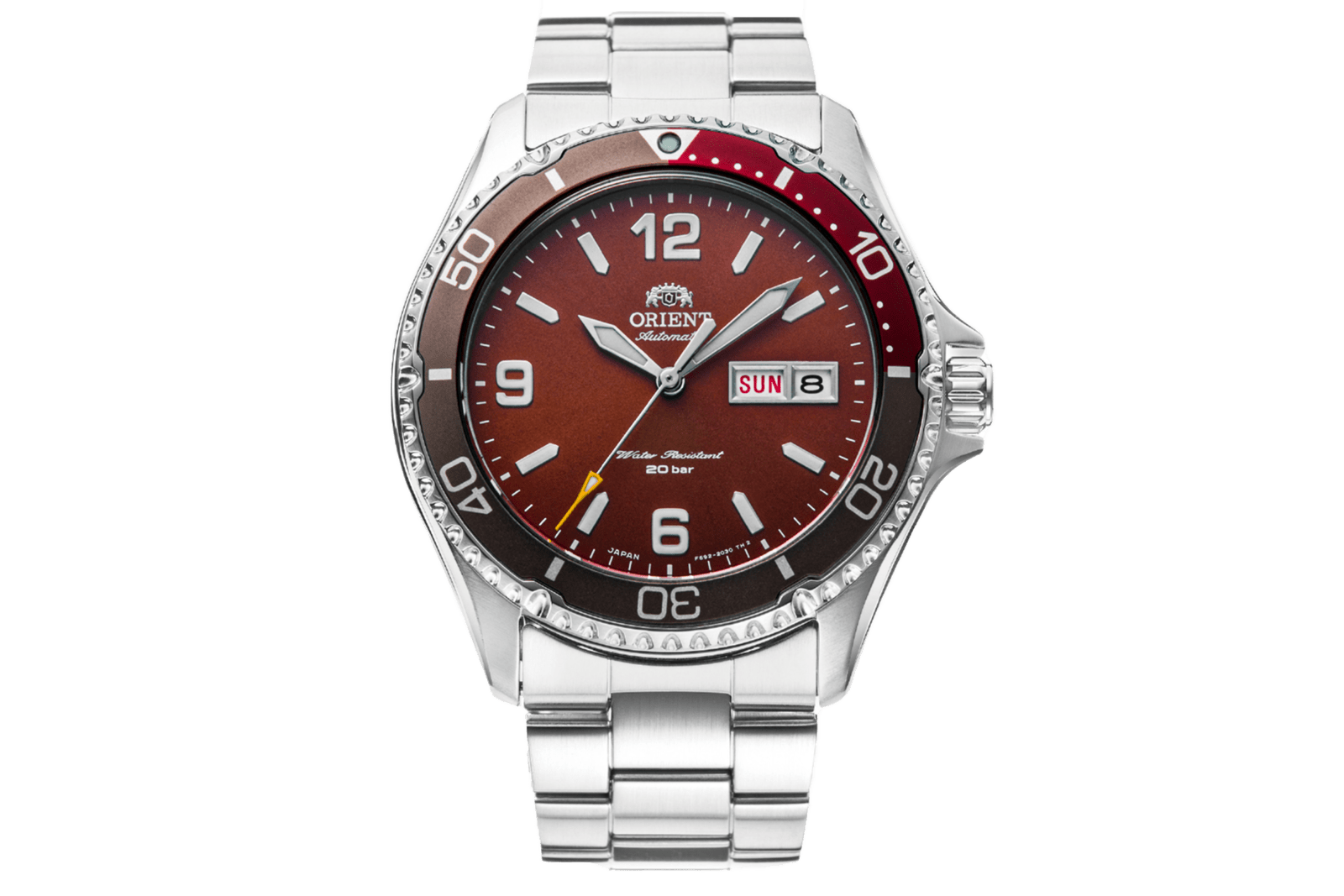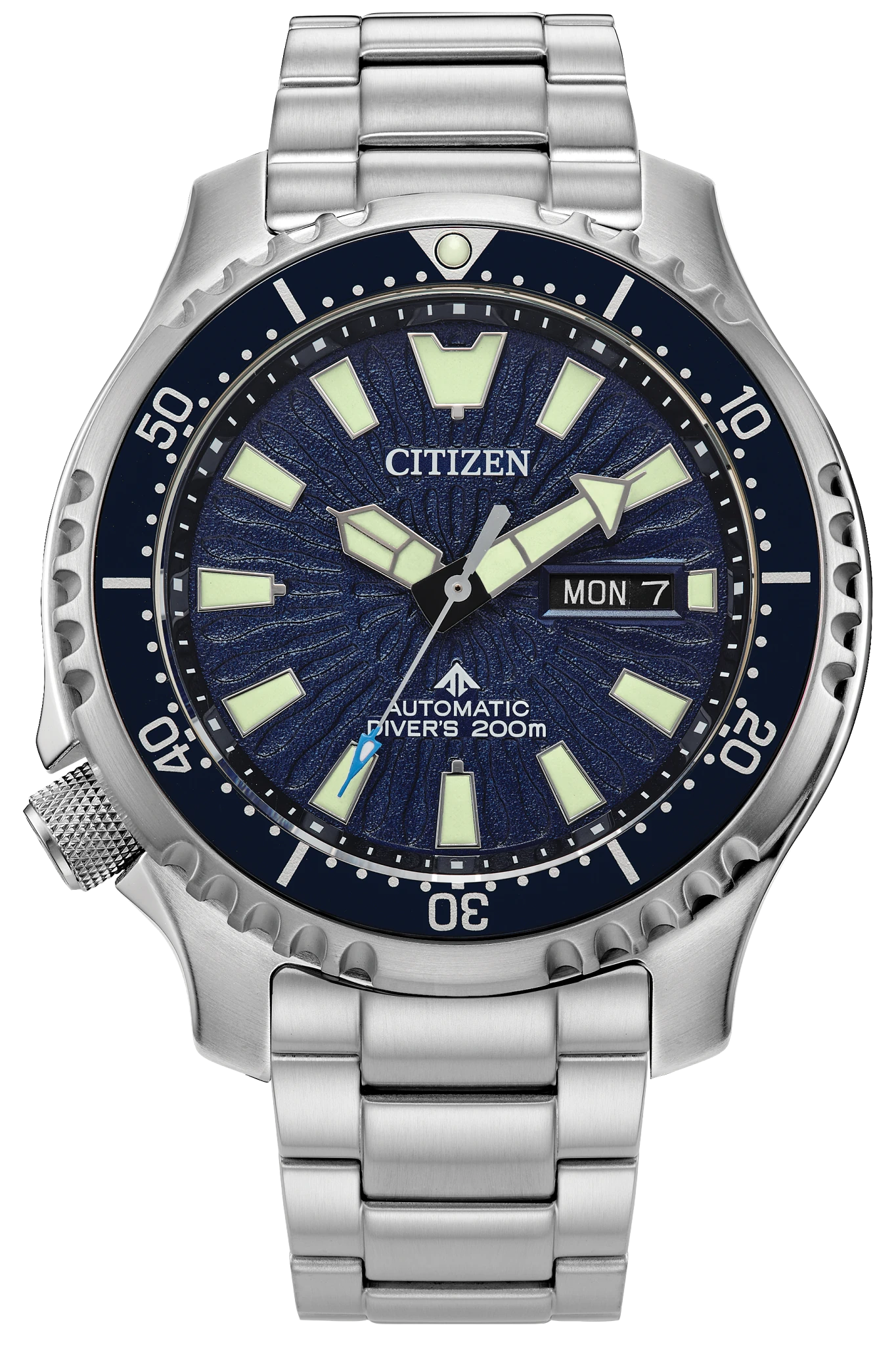
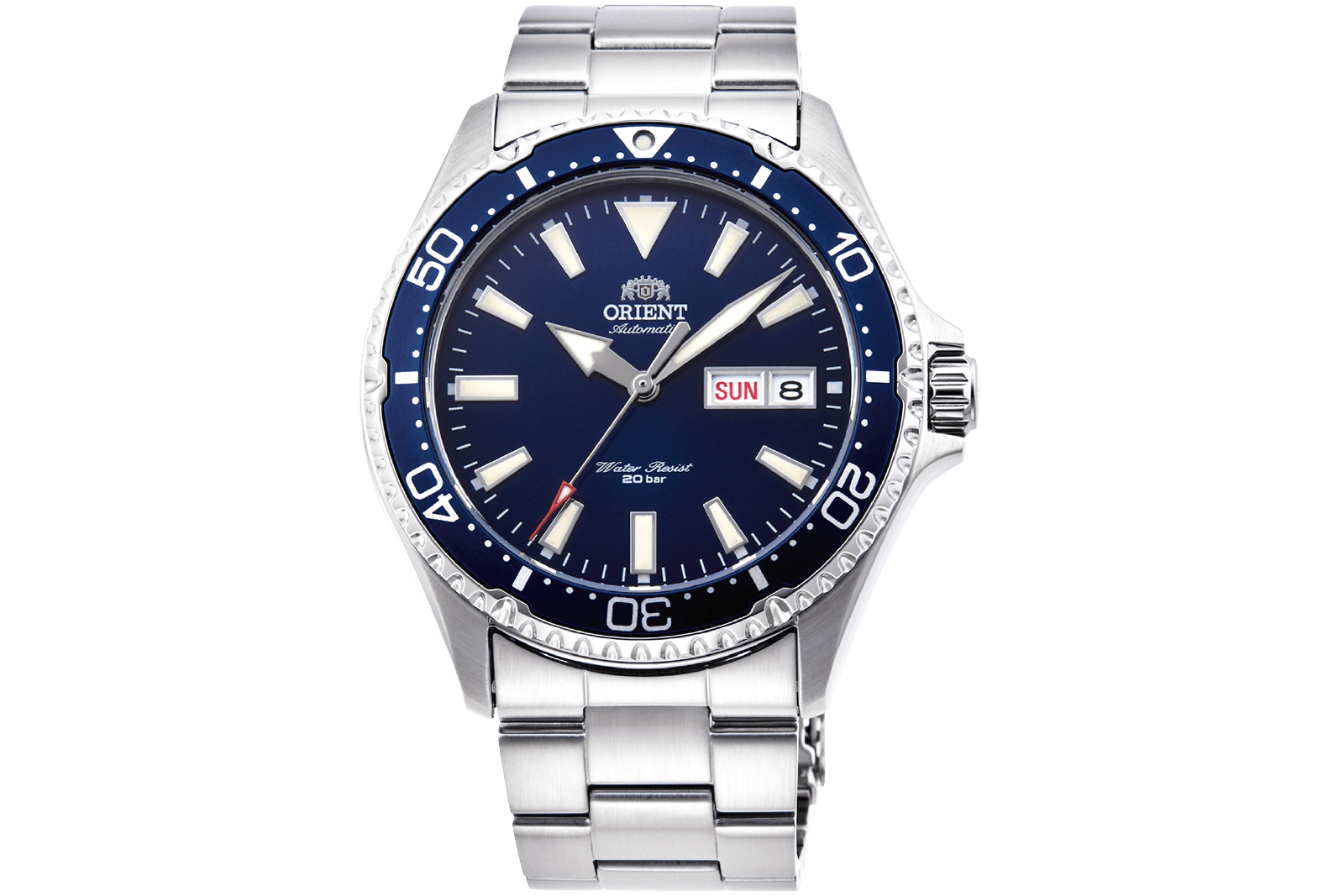
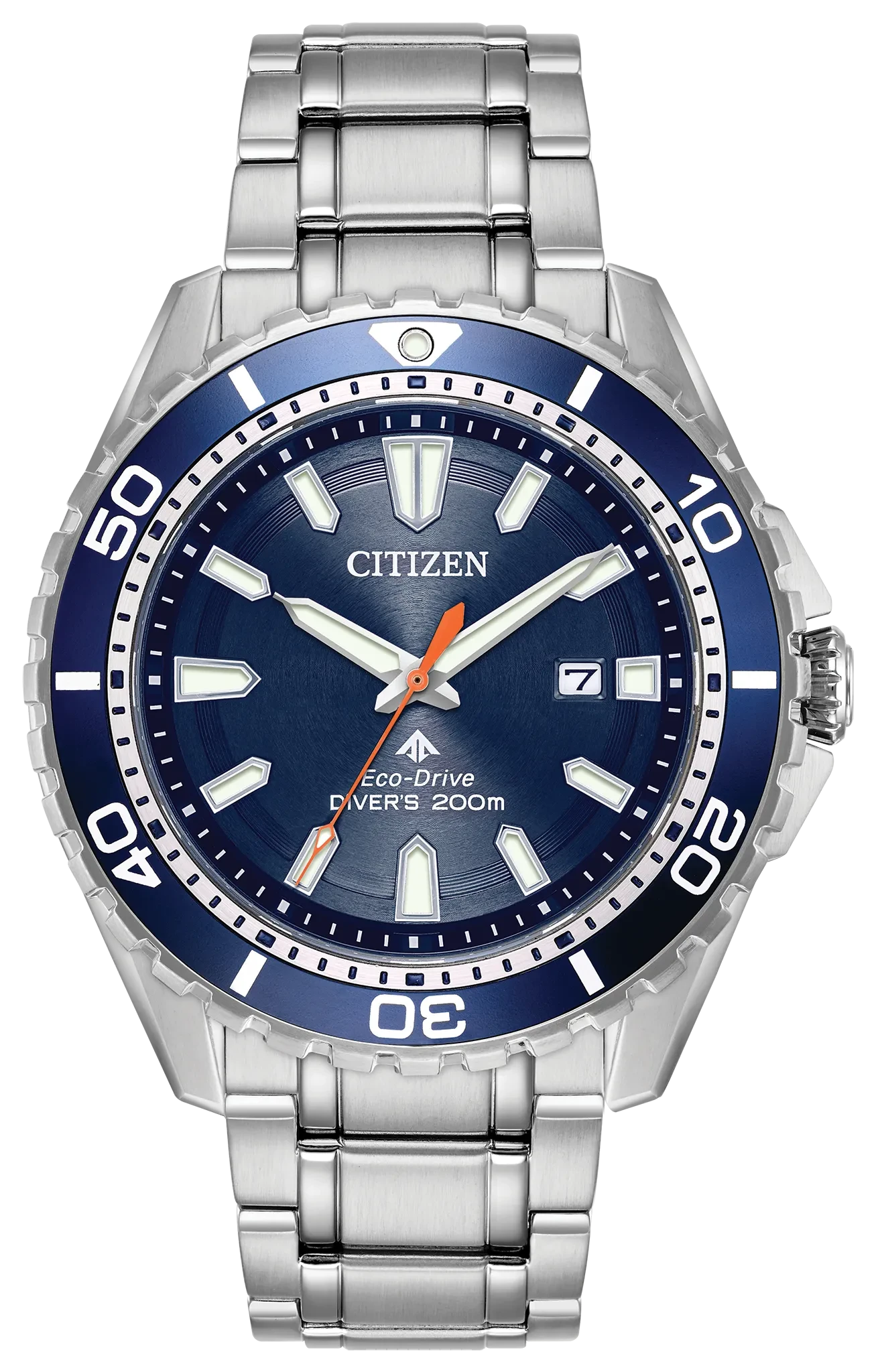
The Orient Kamasu is the one we would buy, unless you dive often. At $375 it beats the $495 Citizen Promaster Dive BN0191-55L on price and crystal and wears smaller. The Citizen’s advantages are the ones that matter underwater and over years of ownership, and it earns them.
The two watches agree on a lot. Both are rated to 200m, both have blue dials and blue unidirectional bezels, and both come on steel bracelets with 22mm lugs. The disagreement is about what moves the hands.
| OrientKamasu (blue) | CitizenPromaster Dive (Eco-Drive) | |
|---|---|---|
| Price (US) | $375 (edge) | $495 |
| Reference | RA-AA0002L39B | BN0191-55L |
| Movement | Orient F6922, automatic | Citizen E168, solar quartz (eco-drive) |
| Power reserve | About 40 hours | Not published |
| Rated accuracy | +25/−15 sec/day | Not published |
| Hacking / hand-winding | Yes / Yes | Not published |
| Jewels | 22 | Not published |
| Beat rate | 21,600 vph | Not published |
| Case diameter | 41.8mm | 45mm |
| Thickness | 12.8mm | Not published |
| Lug to lug | 47mm | Not published |
| Lug width | 22mm | 22mm |
| Crystal | Sapphire (edge) | Mineral |
| Water resistance | 200m | 200m, ISO-compliant diver’s watch (per Citizen) (edge) |
| Bezel | Unidirectional, 120 clicks, blue insert | Unidirectional, azure blue aluminum insert |
| Crown | Screw-down | Not published |
| Lume | Luminous hands and markers | Luminous hands and markers |
| Bracelet / strap | Steel bracelet, fold-over clasp with safety | Steel bracelet, safety fold-over clasp with push buttons |
| Warranty | 3 years (Orient Watch USA) | 5 years (Citizen limited warranty) (edge) |
Price
The Kamasu in blue, reference RA-AA0002L39B, is $375 at Orient Watch USA. The Promaster Dive BN0191-55L is $495 at Citizen.
That makes the Citizen $120 dearer, or 32% more. For the same 200m rating, we worked out what each meter costs. The Kamasu comes to $1.88 per meter of water resistance and the Citizen to $2.48. That is our arithmetic, price divided by rated depth, and it only tells part of the story, because the Citizen’s 200m comes with a formal claim the Orient does not make.
Movement
Here the watches stop being comparable in the usual sense. One is mechanical and one is not.
The Kamasu runs on Orient’s caliber F6922, an automatic with 22 jewels that beats at 21,600 vibrations per hour. It hacks, so the seconds hand stops while you set the time, and it can be wound by hand. Orient rates it at +25 to −15 seconds a day with about 40 hours of reserve. It shows the day, in English or Spanish, and the date. Orient describes it as the successor to its long-running 469-series movement.
The Citizen runs on caliber E168, an Eco-Drive solar quartz movement. Light falling on the dial charges a rechargeable cell, so the watch keeps going in a drawer for as long as its charge lasts and never needs winding. Citizen’s product page does not give an accuracy figure or a power reserve for the BN0191-55L, so we have left those rows empty. As a quartz watch it will keep far better time than any mechanical movement at this price.
If you want a mechanical watch, the Citizen is not an option at all, and the choice is made. If you do not care, the Citizen is the lower-maintenance object, which is why it takes Lowest Upkeep.
Design and Dial
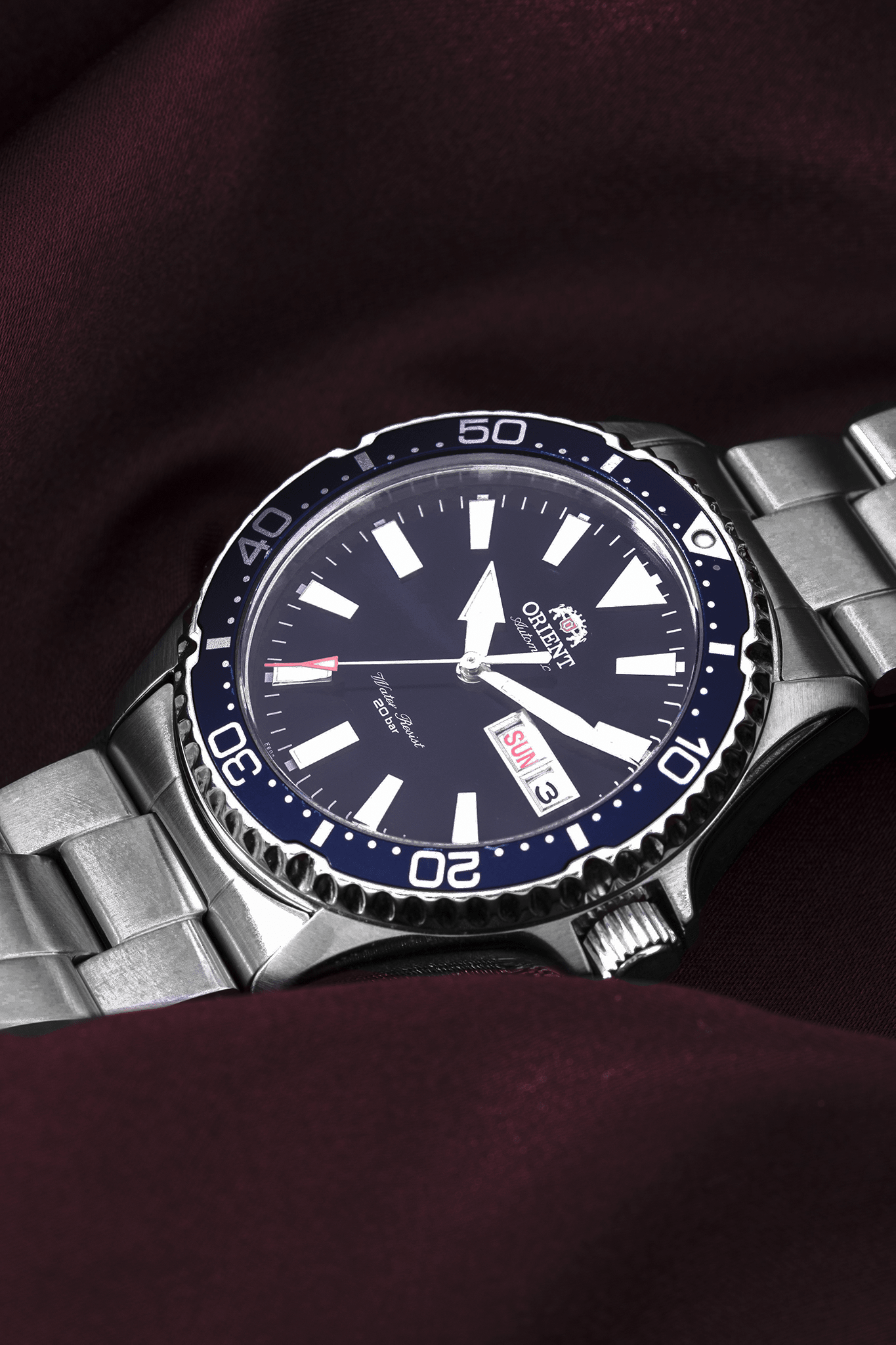
The Kamasu’s blue dial has a sunburst finish, luminous baton markers and arrowhead hands, with a triangle at 12 and a day-date window at 3. Its blue bezel insert carries a 60-minute scale.
The Citizen’s blue dial is busier, with large luminous markers, a date at 3 and a matching azure blue aluminum bezel insert. The dial is printed with Citizen’s diver’s rating, which signals what the watch is meant for.
Both read clearly. We have not awarded the dial.
Case and Crystal
The crystal row is the Kamasu’s strongest point. It has sapphire, which resists scratches far better than glass. The Citizen uses a mineral crystal, which Citizen describes as impact and shatter resistant. On a dive watch that knocks against things, shatter resistance is a fair argument. Over years of daily wear, sapphire’s resistance to scratching is the one more owners will notice.
The Kamasu measures 41.8mm across, 12.8mm thick and 47mm lug to lug. The Citizen is 45mm across. Citizen does not publish its thickness or lug-to-lug, so we can only say that its case is 3.2mm wider. On smaller wrists, that difference in diameter is the one to think about.
Both bezels turn one way only, as a dive bezel should. Orient specifies 120 clicks and a screw-down crown for the Kamasu. Citizen does not list the crown type or click count on the BN0191-55L’s page.
Water Resistance
Both are rated to 200m, but they do not make the same claim.
Citizen describes the BN0191-55L as ISO-compliant, meaning it meets ISO 6425, the international standard for divers’ watches. That standard covers more than depth. It also requires features such as a way of timing a dive that can be read in the dark. Orient makes no ISO claim for the Kamasu, and its dial reads “Water Resistant” rather than “Diver’s”. Our guide to water resistance ratings explains the difference.
For anyone who scuba dives, that settles the row, and the Citizen takes Best for Diving. For swimming and everyday wear, both have more rating than they will ever use.
On the Wrist
On published figures, the Kamasu is the more versatile size. A 41.8mm case with a 47mm lug-to-lug suits a wide range of wrists, and at 12.8mm it is moderate for a 200m diver.
The Citizen’s 45mm diameter makes it the larger watch. Without a published thickness or lug-to-lug we cannot say how much longer it is, but 45mm is a big diver by current standards. Our full Kamasu review covers its proportions in more detail.
Long-Term Ownership
Citizen gives a five-year limited warranty. Orient Watch USA gives three. The warranty row goes to the Citizen.
Running costs differ too. The Kamasu will need a mechanical service in time, as every automatic does. The Citizen does not need battery changes in the usual way, because it recharges from light. The Kamasu’s sapphire crystal is less likely to need replacing.
Value
Best Value goes to the Kamasu. For $120 less it offers sapphire, an in-house automatic movement with a day display, a screw-down crown and a more compact case. That is a strong spec sheet at $375.
The Citizen’s value is in its rating and its convenience. An ISO-compliant diver that charges itself and carries five years of cover is a sensible buy at $495, especially for someone who will actually dive with it.
Verdict
- Best Value
- Orient Kamasu (blue)
- Best for Diving
- Citizen Promaster Dive (Eco-Drive)
- Lowest Upkeep
- Citizen Promaster Dive (Eco-Drive)
- Editor’s Pick
- Orient Kamasu (blue)
The Orient Kamasu takes Best Value and our Editor’s Pick. At $375 it costs $120 less than the Citizen, it has sapphire instead of mineral glass, and it gives you an in-house mechanical movement in a 41.8mm case that suits most wrists.
The Citizen Promaster Dive BN0191-55L takes Best for Diving and Lowest Upkeep. Its ISO-compliant rating, its light-powered movement and its five-year warranty are real advantages, and for a diver who wants a watch that never needs winding, they outweigh the Orient’s crystal and price.